Skip to content




The best whole home humidifiers for Oklahoma winters are bypass, fan-powered, or steam models that integrate directly with your HVAC system. The right choice depends on your home’s size, budget, and heating equipment. These systems maintain indoor humidity between 30-50% when winter heating can drop levels below 20%, protecting both your health and your home from the damaging effects of dry air.
Key Takeaways
- Whole-home humidifiers maintain the EPA-recommended 30-50% indoor humidity when Oklahoma’s winter heating systems dry out indoor air to dangerous levels
- Three main types exist: bypass ($500-$700 installed), fan-powered ($700-$800), and steam ($1,000+), each suited to different home sizes and needs
- Proper humidity can reduce heating costs by 3-4% for every degree you lower your thermostat while still feeling comfortable
- Professional installation ensures compatibility with your existing HVAC system and correct sizing for your specific home
- Indoor humidity of 40-60% can reduce airborne virus survival by up to five times compared to dry air below 40%
Why Do Oklahoma Homes Need Humidifiers in Winter?
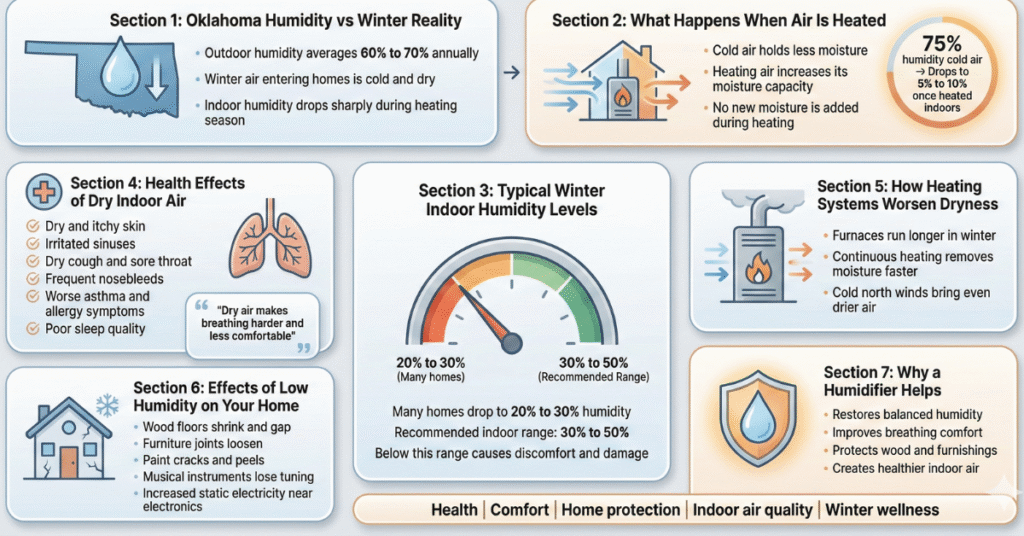
Oklahoma’s climate presents a unique challenge for indoor comfort. According to the Oklahoma Climatological Survey, annual average relative humidity ranges from about 60% in the panhandle to just over 70% in the east and southeast. However, outdoor humidity tells only part of the story. When cold, dry winter air enters your home and gets heated by your furnace, indoor humidity levels can plummet dramatically.
How Heating Systems Dry Out Indoor Air
When your furnace heats cold winter air, something important happens. The air’s capacity to hold moisture increases, but no additional moisture gets added. This causes relative humidity to drop sharply. Research shows that air at freezing temperatures with 75% relative humidity can drop to as low as 5-10% when heated indoors.
In many Oklahoma homes, indoor humidity levels fall to 20-30% during the heating season. The U.S. Environmental Protection Agency recommends keeping indoor humidity between 30-50% for optimal health and comfort. When levels drop below this range, you’ll start noticing problems throughout your home.
Cold air from the north brings dry conditions to Oklahoma during winter months. As your heating system runs continuously to maintain warmth, it accelerates moisture loss from your indoor environment. The longer your furnace operates, the faster this drying effect occurs.
Health and Home Effects of Low Humidity
Low indoor humidity affects your body in several ways. Dry air pulls moisture from your skin, sinuses, and throat, leading to uncomfortable symptoms that worsen throughout the winter season.
Common health effects of low humidity include:
- Dry, itchy, and cracking skin
- Irritated sinuses and increased susceptibility to respiratory infections
- Scratchy throat and dry cough, especially in the morning
- Frequent nosebleeds from dried nasal passages
- Worsened asthma and allergy symptoms
- Poor sleep quality due to nasal congestion and snoring
Dr. Sobia Farooq, a pulmonologist at Cleveland Clinic, explains the connection between humidity and respiratory health: “A humidifier is one of the best ways to improve indoor air quality and support better breathing. When the air is dry, your respiratory system just isn’t happy.”
Beyond personal comfort, dry air damages your home. Wood floors develop gaps as boards shrink. Furniture joints loosen and crack. Paint peels from walls. Musical instruments go out of tune. Even your electronics face increased risk from static electricity buildup.
What Are the Different Types of Whole-Home Humidifiers?
Whole-home humidifiers connect directly to your HVAC system, distributing moisture through your existing ductwork. Unlike portable units that only treat single rooms, these systems maintain consistent humidity levels throughout your entire home. According to Carrier, three main types serve different needs and budgets.
Bypass Humidifiers (Best for Small to Medium Homes)
Bypass humidifiers represent the most basic and affordable whole-home option. These units connect to both the supply and return sides of your ductwork, using a bypass duct to redirect warm air from your furnace over a water-saturated pad.
How bypass humidifiers work:
- Warm air from your furnace enters the humidifier through a bypass duct
- The air passes over a moistened evaporator pad
- Water evaporates into the warm air stream
- Humidified air rejoins the main airflow and distributes through your home
Bypass humidifiers produce approximately 12-17 gallons of moisture per day. They work only when your furnace is running, relying on the furnace’s heat to evaporate water from the pad. Installation typically costs between $500 and $700, making them the most budget-friendly option.
These units work best for homes up to 2,500 square feet with standard forced-air heating systems. They use minimal electricity since they don’t have their own fan, keeping operating costs low.
Fan-Powered Humidifiers (Best for Medium to Large Homes)
Fan-powered humidifiers include a built-in fan that actively draws air across the water panel. This design increases moisture output by approximately 50% compared to bypass models without requiring additional ductwork.
The internal fan provides several advantages. These units produce more humidity faster, work more effectively with modulating or variable-speed furnaces, and take up less space because they don’t need a bypass duct connection. They connect directly to the supply plenum.
Fan-powered humidifiers typically produce 17-18 gallons of moisture per day. Installation costs range from $700 to $800. Annual operating costs run approximately $40-$50 for electricity, plus the cost of replacement water panels.
For medium to large Oklahoma homes between 2,000 and 3,500 square feet, fan-powered humidifiers offer an excellent balance of performance and value. They’re particularly well-suited for newer homes with high-efficiency heating systems.
Steam Humidifiers (Best for Large Homes or Precise Control)
Steam humidifiers represent the most powerful and precise whole-home option. These units use electricity to boil water, producing steam that gets distributed through your ductwork. Unlike evaporative models, steam humidifiers don’t depend on your furnace’s heat output.
Key advantages of steam humidifiers:
- Produce up to 34 gallons of moisture per day
- Work independently of furnace operation
- Provide the most consistent humidity control
- Operate more quietly than fan-powered models
- Deliver hygienic steam (boiling eliminates pathogens)
Steam humidifiers excel in large homes up to 4,000-5,000 square feet or in situations requiring precise humidity control. They’re ideal for homes with valuable wood floors, musical instrument collections, or occupants with respiratory sensitivities.
Installation costs typically exceed $1,000, and these units consume more electricity than evaporative alternatives. However, they’re extremely efficient with water usage, often achieving 90% efficiency compared to drain-through evaporative models.
How Do You Choose the Right Humidifier for Your Oklahoma Home?
Selecting the best whole-home humidifier requires evaluating several factors specific to your situation. The right choice balances your home’s size, your existing HVAC equipment, and your budget for both installation and ongoing operation.
Home Size and Square Footage Considerations
Your home’s volume determines how much moisture your humidifier needs to produce. Larger spaces require more powerful units to maintain consistent humidity levels throughout.
| Home Size | Recommended Type | Daily Output Needed |
| Under 1,500 sq ft | Bypass | 10-12 gallons |
| 1,500-2,500 sq ft | Bypass or Fan-Powered | 12-17 gallons |
| 2,500-3,500 sq ft | Fan-Powered | 17-18 gallons |
| 3,500-5,000 sq ft | Steam | 20-34 gallons |
Building tightness also matters. Older Oklahoma homes with more air leaks require higher-capacity humidifiers because moisture escapes more quickly. Newer, well-sealed homes retain humidity better and may achieve good results with smaller units.
If you’re unsure about your home’s characteristics, a professional assessment can identify air leakage issues and recommend the appropriate humidifier capacity. Understanding how residential HVAC systems work helps you make informed decisions about humidity control equipment.
HVAC System Compatibility
Your existing heating system influences which humidifier types will work best. Standard single-stage furnaces pair well with any humidifier type. However, modulating or variable-speed systems require special consideration.
Bypass humidifiers may underperform with modulating furnaces because these systems often run at lower heat outputs. The reduced temperature means less water evaporates from the pad. Fan-powered or steam humidifiers typically work better with high-efficiency heating equipment.
Homes with heat pumps face additional challenges. Heat pumps produce lower supply air temperatures than gas furnaces, reducing evaporative humidifier effectiveness. Steam humidifiers, which generate their own heat, often prove more effective in heat pump applications.
Your ductwork location matters too. If ducts run through unconditioned spaces like attics or crawlspaces, you’ll want to coordinate humidifier operation with furnace cycles to prevent condensation issues in cold ductwork.
Budget and Long-Term Operating Costs
Initial installation represents only part of your total investment. Understanding ongoing costs helps you choose the most economical option for your situation.
Typical costs by humidifier type:
- Bypass: $500-$700 installed, $20-$40 annual operating cost
- Fan-Powered: $700-$800 installed, $40-$50 annual operating cost
- Steam: $1,000-$2,500 installed, $100-$200 annual operating cost
All whole-home humidifiers require periodic maintenance, primarily replacing water panels or steam canisters. Evaporative models need new pads at least once per heating season, sometimes twice in hard water areas. Steam humidifiers require canister replacement based on usage and water quality.
For help comparing humidity control options, our humidifier vs dehumidifier guide explains when each type of equipment makes sense for Oklahoma homes.
What Are the Benefits of Whole-Home Humidification?
Installing a whole-home humidifier delivers benefits that extend far beyond simple comfort. From improved health outcomes to lower energy bills and protected home investments, proper humidity control pays dividends throughout the winter season.
Improved Comfort and Respiratory Health
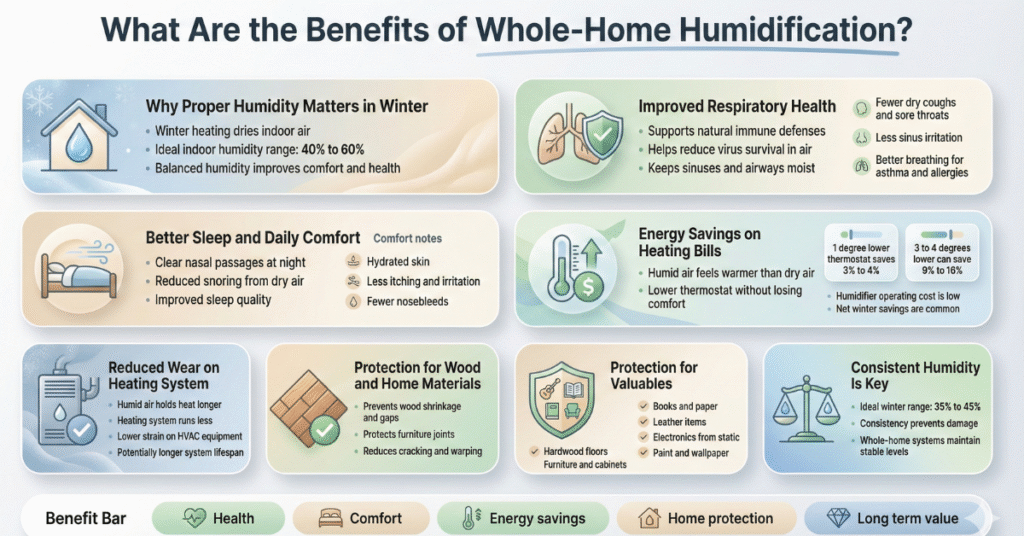
Maintaining proper indoor humidity between 40-60% supports your body’s natural defenses against illness. Research from Stanford University found that indoor relative humidity of 40-60% creates conditions where naturally occurring disinfectant compounds in airborne microdroplets help inactivate viruses.
Dr. Richard Zare, chemist at Stanford University, explains: “Indoor relative humidity of 40% to 60% has long been recommended by experts, and now this research points to a significant benefit: humidity in this range naturally creates anti-viral compounds in the air’s microdroplets.”
Studies show that flu viruses retain their infectious nature up to five times longer in dry air below 40% compared to properly humidified environments. Professor Akiko Iwasaki of Yale University, an investigator for the Howard Hughes Medical Institute, notes that maintaining indoor humidity of at least 40% “is a proactive way to combat the spread of viruses from infected to susceptible hosts.”
Dr. Shaila Pai-Verma, a primary care physician at Rush University Medical Center, recommends humidifiers specifically for respiratory health: “A humidifier is especially helpful for people with certain upper respiratory conditions like sinusitis or an asthma flare-up, and for certain skin conditions.”
Beyond illness prevention, proper humidity eliminates many winter discomforts. Your skin stays hydrated. Sinuses remain moist and functional. Sleep quality improves as nasal passages stay clear throughout the night.
Energy Savings on Winter Heating Bills
Humid air feels warmer than dry air at the same temperature. This principle translates directly into energy savings during Oklahoma winters. When your home maintains proper humidity levels, you can lower your thermostat while still feeling comfortable.
According to the EPA, for every degree you lower your thermostat, you save approximately 3-4% on heating costs. If proper humidity allows you to set your thermostat 3-4 degrees lower without sacrificing comfort, you could reduce heating bills by 9-16%.
The math works in your favor even when accounting for humidifier operating costs. A typical whole-home humidifier costs $40-$200 annually to operate. Many homeowners report net savings of $50 or more per month during peak heating season.
Humid air also retains heat more effectively than dry air. Your heating system doesn’t work as hard to maintain comfortable temperatures, reducing wear on equipment and potentially extending its service life. Following a seasonal HVAC maintenance checklist ensures both your heating system and humidifier operate at peak efficiency.
Protection for Wood Floors, Furniture, and Musical Instruments
Low humidity causes wood to shrink, crack, and warp. Hardwood floors develop gaps between boards. Furniture joints loosen. Doors and windows stick or gap. These problems develop gradually but can cause expensive damage over time.
Maintaining consistent humidity between 35-45% during winter protects your wood investments. The key is consistency. Dramatic humidity swings cause more damage than steady low humidity because wood expands and contracts repeatedly.
Musical instruments suffer particularly in dry conditions. Acoustic guitars, pianos, violins, and other wooden instruments require stable humidity to maintain proper tone and structural integrity. Many instrument manufacturers recommend 40-50% relative humidity year-round.
Beyond wood, proper humidity protects:
- Leather furniture and accessories
- Books and paper documents
- Houseplants that struggle in dry air
- Electronics vulnerable to static discharge
- Paint and wallpaper that can crack and peel
How Is a Whole-Home Humidifier Installed and Maintained?
Professional installation ensures your whole-home humidifier operates safely and effectively. Proper maintenance keeps it running efficiently throughout each heating season.
Professional Installation Process
Whole-home humidifier installation involves connecting the unit to your HVAC system, plumbing, and electrical supply. A qualified technician completes several important steps during installation.
The installation process includes:
- Assessment: Evaluating your HVAC system, ductwork, and home size to confirm proper humidifier selection
- Mounting: Securing the humidifier to the supply or return plenum (location depends on unit type)
- Duct connection: Creating openings and installing mounting hardware for airflow
- Water line: Running a supply line from your home’s plumbing to the humidifier
- Drain line: Installing drainage for excess water (evaporative models)
- Electrical: Connecting power and integrating with your thermostat or humidistat
- Testing: Verifying proper operation and adjusting humidity settings
Most installations take 2-4 hours. The technician will explain how to operate your new humidifier and recommend initial humidity settings based on your home’s characteristics and Oklahoma’s winter conditions.
For comprehensive indoor air quality, many homeowners combine humidification with air purification systems to address multiple comfort and health concerns.
Seasonal Maintenance Requirements
Whole-home humidifiers require regular maintenance to operate effectively and avoid problems like mineral buildup or bacterial growth.
Essential maintenance tasks:
- Replace water panels: Evaporative humidifiers need new pads at least once per heating season. Hard water areas may require replacement every 2-3 months.
- Replace steam canisters: Steam humidifiers typically need new canisters once per season, though usage and water quality affect timing.
- Clean the unit: Wipe down interior surfaces and remove mineral deposits annually.
- Check water supply: Verify the supply line flows freely and has no leaks.
- Inspect drain lines: Ensure proper drainage without clogs or blockages.
- Test operation: Confirm the humidistat accurately reads humidity levels and triggers the unit appropriately.
The best time for humidifier maintenance is early fall, before you need the unit for winter. Many homeowners schedule this service alongside their annual furnace tune-up for convenience. An HVAC maintenance plan can include humidifier service to ensure your entire comfort system stays in top condition.
Ready to Improve Your Home’s Winter Comfort?
Oklahoma winters don’t have to mean months of dry skin, static shocks, and respiratory discomfort. A whole-home humidifier maintains healthy indoor humidity levels automatically, protecting your family’s health while preserving your home and reducing heating costs.
Whether you need a budget-friendly bypass unit for a smaller home or a powerful steam humidifier for precise control in a larger space, professional guidance helps you choose the right solution. Proper sizing and installation ensure you get the full benefits of whole-home humidification.
Girdner Heat and Air serves Stilwell, Oklahoma and surrounding communities in both Oklahoma and Arkansas. Our team can assess your home’s humidity needs, recommend the best humidifier type for your situation, and provide professional installation that integrates seamlessly with your existing HVAC system.
Have questions about whole-home humidifiers? Ready to schedule an assessment? Contact Girdner Heat and Air today to start enjoying healthier, more comfortable indoor air this winter.