Skip to content



Homeowners in Stilwell face an important decision when it’s time to install or replace their air conditioning system. The choice between central air and mini split options affects not just your comfort, but also your energy bills, installation costs, and how your home looks.
At Girdner Heat and Air LLC, we help Stilwell homeowners make informed decisions about their HVAC system every day.
Understanding how each cooling system works and what makes them different will help you choose the option that keeps your family comfortable. Let’s explore the pros and cons of central air vs mini split systems to find your perfect cooling solution.
Understanding Central Air Conditioning Systems
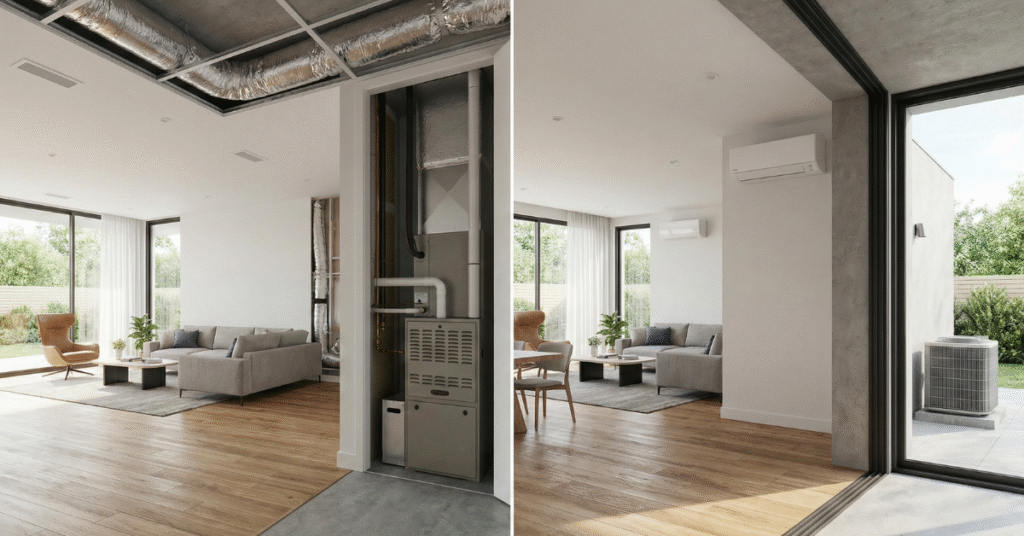
Central air conditioning uses a network of ducts to distribute cool air throughout your entire home from a single outdoor unit. The system connects to a thermostat that controls the temperature for your whole house. When you adjust the thermostat, the central air conditioning system kicks on and pushes conditioned air through vents in every room.
This type of system has been the standard in American homes for decades. If your home already has ductwork from a furnace or existing AC system, central air builds on that existing infrastructure. The central air conditioner consists of an outdoor condenser unit and an indoor air handler that work together to heat and cool your space.
Benefits of Traditional Central Air
Whole-Home Cooling
- One central air system cools every room in your house evenly
- No need to manage multiple units or worry about hot spots in certain areas
- Cool air throughout the home reaches every space consistently
Hidden Components
- The only visible parts are vents and the outdoor unit
- No indoor air handlers take up wall space or change your room’s appearance
- Maintains clean aesthetic throughout your living spaces
Property Value
- Homes with central ac typically sell for more than homes without it
- Buyers expect this feature in most markets
- Installing a central air conditioning system adds long-term home value
Works With Existing Ductwork
- If you already have ducts for heating, adding central air is straightforward
- Girdner Heat and Air LLC can assess your current ductwork during installation planning
- Reduces overall installation costs compared to starting from scratch
Drawbacks of Central Air Systems
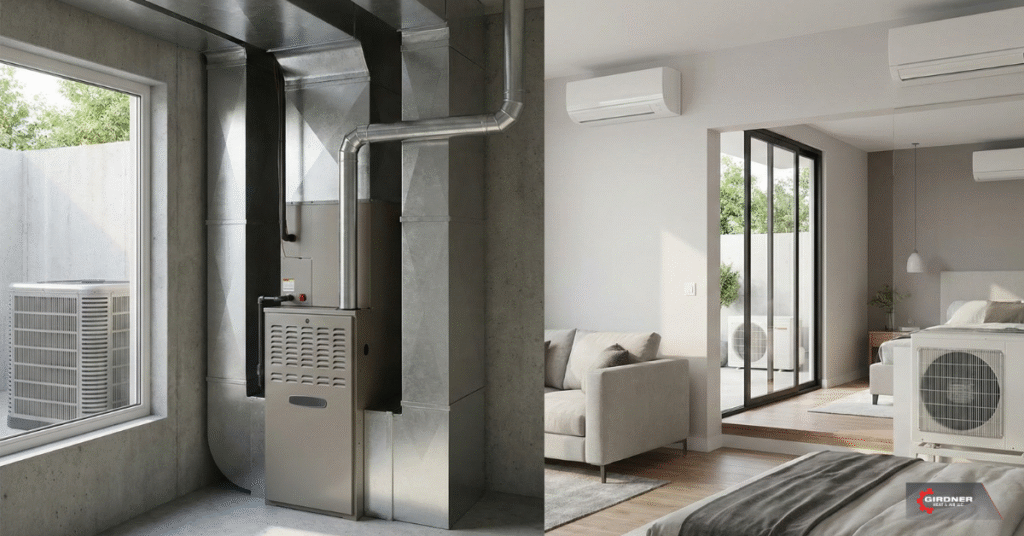
Installing central ac requires ductwork throughout your home. If you don’t have ducts, installation becomes significantly more expensive and invasive. You’ll need to cut into walls and ceilings to run the ductwork, which adds time and cost to the project.
Energy and Efficiency Concerns
- Energy efficiency suffers from duct losses, even with well-sealed systems
- Some cool air escapes before reaching your rooms
- You’re cooling your entire home to the same temperature, even unused rooms
- Higher energy bill compared to ductless systems
- Less efficient than central air systems with zone control capabilities
Understanding Ductless Mini Split Systems
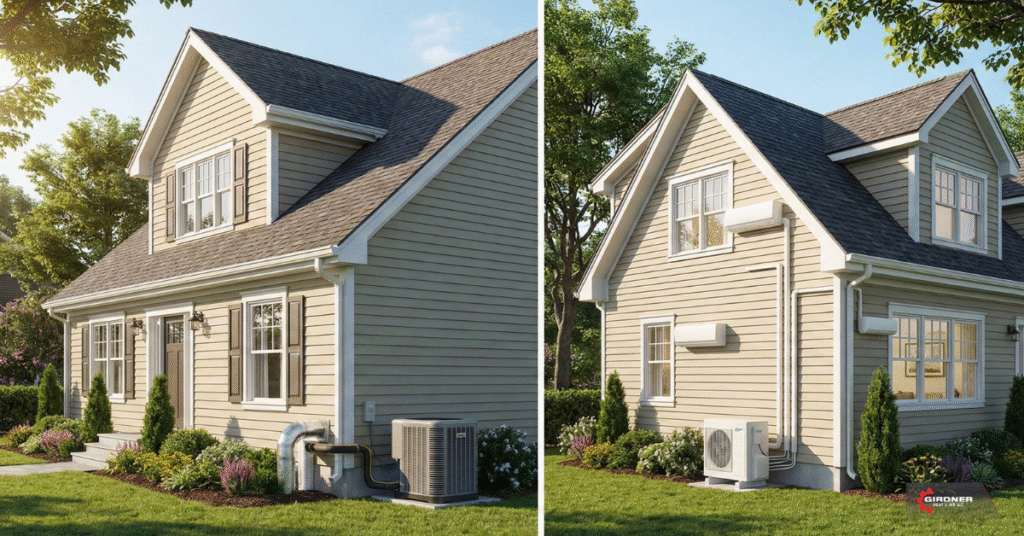
Mini split systems work without ductwork. They consist of an outdoor unit and an indoor unit mounted on your walls, connected through a small conduit. Each indoor unit can be controlled independently, giving you precise temperature control in different areas.
The outdoor unit and an indoor unit connect through a three-inch hole in your wall. This carries refrigerant lines, power cables, and drainage. Installation requires minimal structural changes, making it far less invasive than traditional central air conditioning.
Benefits of Mini Split Heat Pump Systems
No Ductwork Required
- Perfect for homes without existing ducts, additions, or mobile homes
- Mini splits don’t require cutting into walls throughout your house
- Ideal where running ductwork isn’t practical or cost-effective
Zone Control
- Set different temperatures in different rooms with multiple indoor air handlers
- Cool bedrooms at night while keeping living areas warmer to save energy
- Use a mini split system only where you need cooling
- Better indoor air quality with individual air filter units in each room
Energy Efficiency
- Without duct losses, mini-split systems often use less energy
- More energy-efficient than central air in most applications
- You’re only cooling the spaces you’re actually using
- Lower energy bill month after month
Flexible Installation and Repair
- Add cooling to specific problem areas like sunrooms or converted garages
- Simple installation process compared to ducted system options
- Easy access for cleaning and repair of individual units
- Mini split air conditioner units mount anywhere you need them
Heating and Cooling
- Most mini-split heat pump models provide heat or cool air year-round
- One system for complete climate control
- Heat pump technology delivers efficient temperature management
- Mini split heat pump options replace both furnace and AC
Drawbacks of Ductless Mini-Splits
The indoor unit components are visible on your walls. Some homeowners find them unattractive, though modern designs have become sleeker. Cost per room can be higher if you need multiple mini split units for whole-home coverage.
Maintenance Considerations
- Cleaning required for each indoor air quality filter location
- Instead of changing one central system filter, you maintain multiple units
- Regular maintenance ensures optimal performance
- Each air filter needs attention several times per year
Quick Comparison: central air vs mini split systems
| Feature | Central Air | Ductless Mini Splits |
| Installation Cost | $3,500-$7,500 (with ducts) / $10,000+ (without ducts) | $2,000-$4,000 per zone / $8,000-$20,000 whole home |
| Energy Efficiency | Moderate (duct losses reduce efficiency) | High (no duct losses, zone control) |
| Appearance | Hidden (vents only) | Visible wall units |
| Ductwork Required | Yes | No |
| Zone Control | Limited | Excellent |
| Best For | Homes with existing ducts | Homes without ducts, mobile homes, additions |
| Maintenance | Single filter location | Multiple filter locations |
| Heating Capability | Requires separate furnace | Most models heat and cool |
| Installation Time | 1-3 days (with ducts) / 1-2 weeks (without) | 1 day per zone |
Cost Comparison for Stilwell Homeowners
Installation costs vary widely based on your home’s current setup. Installing a central ac system typically costs between $3,500 and $7,500 if you already have ductwork. Without ducts, expect $10,000 or more for a complete installation of traditional central air conditioning.
A single mini split ranges from $2,000 to $4,000 per zone for one-room setups. A whole-home ductless system with multiple indoor units can cost $8,000 to $20,000 depending on coverage needs. Long-term energy costs favor mini split systems in most cases due to superior zone control and elimination of duct losses.
Girdner Heat and Air LLC offers financing options for qualifying customers, making either cooling system more affordable with manageable monthly payments. Our team provides transparent pricing for installation, repair, and cleaning services.
Which System Works Best for Your Home?
Your home’s characteristics largely determine which option makes sense. Mini splits are great for specific situations, while central air pros shine in others. Consider these factors when comparing ductless mini split options to traditional air conditioning.
Choose Central Air If:
- Your home already has ductwork in good condition
- You want a traditional, hidden cooling system
- You prefer simple whole-home temperature control
- You have a larger home that needs consistent cool air throughout
Choose a Mini-Split System If:
- Your home lacks ductwork and adding it isn’t feasible
- You own a mobile home or have additions without duct access
- You want independent temperature control with one or more indoor air handlers
- Energy efficiency is your top priority
- You need a heat pump system for both heating and cooling
Special Considerations for Mobile Homes
Mobile homes present unique challenges that often make ductless mini-split systems the better choice. Running ductwork through mobile home construction is difficult and expensive. The limited space doesn’t accommodate traditional central air systems well.
Mini splits install easily in mobile homes with minimal impact. Girdner Heat and Air LLC has extensive experience working with mobile home owners in Stilwell, providing efficient cooling solutions that work with your home’s unique requirements. The superior energy efficiency also helps control utility costs in homes with less insulation.

Questions About Mini Splits and Central Air? We Have Answers
Both central air units and ductless mini splits have their place in Stilwell homes. Your best choice depends on your budget, existing infrastructure, cooling preferences, and long-term plans. The pros and cons of ductless versus traditional central hvac systems require careful consideration.
The team at Girdner Heat and Air LLC can assess your specific situation and provide honest recommendations. We offer upfront pricing and customer-first care for every installation, repair, cleaning, and maintenance service. Our expertise in both systems means you’ll get reliable guidance backed by years of experience.
Whether you need air conditioning service, emergency repair, or want to explore your options for a new system, we’re here to help. Contact Girdner Heat and Air LLC today to schedule a consultation and find the perfect cooling solution for your home.