Skip to content
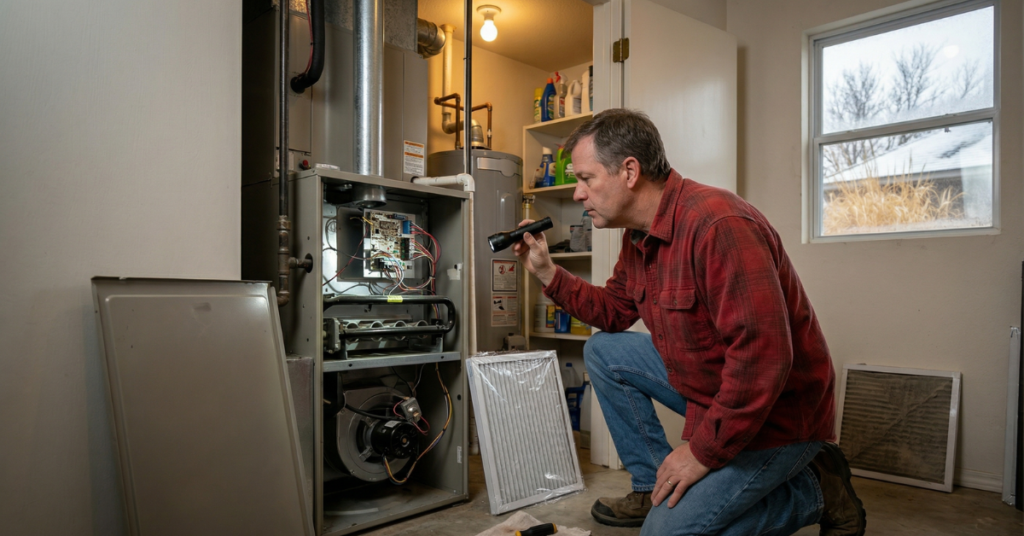
The most common furnace repairs Oklahoma homeowners face include dirty or clogged filters, ignition system failures, thermostat malfunctions, blower motor problems, and cracked heat exchangers. Most repairs cost between $150 and $600, though major component replacements like heat exchangers can reach $1,500 to $3,000. Understanding which problems you can troubleshoot yourself and which require professional help keeps your home safe and your heating costs under control.
Oklahoma winters are unpredictable. A mild afternoon can turn into a below-freezing night with little warning, and when that happens, your furnace needs to respond immediately. This guide walks you through the most common furnace problems, what you can safely check on your own, when to call a professional, what repairs typically cost, and how to prevent breakdowns before they happen.
Key Takeaways
- Filter-related issues are the leading cause of furnace breakdowns and are the easiest to prevent with monthly checks during heating season.
- A yellow or flickering furnace flame instead of steady blue is a potential carbon monoxide hazard that requires immediate professional attention.
- Oklahoma’s sudden temperature swings stress furnace components more than steady cold weather, making fall maintenance critical before the first freeze.
- Most furnace repairs cost $150 to $600, but emergency calls during cold snaps can cost two to three times the standard rate.
- Annual professional tune-ups catch safety and efficiency problems that homeowners can’t detect on their own, helping your furnace last its full 15 to 20 year lifespan.
Furnace Repair Guide: How to Fix Common Issues?
Furnaces are complex systems with multiple components that can wear down over time, but a handful of problems account for the majority of service calls. Knowing what typically goes wrong helps you recognize issues early and respond appropriately.
Dirty or Clogged Air Filters
A dirty air filter is the single most common cause of furnace problems. When the filter clogs with dust, pet hair, and debris, it restricts airflow into the system. That restricted airflow forces the furnace to work harder, causes the heat exchanger to overheat, and can trigger the safety limit switch to shut the system down entirely. According to Bryant, most homeowners spend between $150 and $600 on typical furnace repairs, and many of those service calls could have been avoided with a simple filter change.
Ignition System Failures
The ignitor is the component that lights the burners to start the heating cycle, and according to Angi, it fails more frequently than any other furnace part. Older furnaces use a standing pilot light that can blow out, while newer models rely on electronic ignition systems that can crack or wear out over time. When the ignitor fails, the furnace either won’t start at all or will attempt to light and then shut down.
Thermostat Malfunctions
Sometimes the problem isn’t the furnace itself but the thermostat controlling it. Dead batteries, miscalibrated sensors, loose wiring, or a thermostat placed too close to a heat source can all cause the furnace to behave erratically, fail to start, or cycle on and off at the wrong times. These issues are easy to overlook because homeowners naturally assume the furnace is the source of the problem.
Blower Motor and Heat Exchanger Issues
The blower motor circulates heated air through your ductwork and into your living spaces. When it fails, you may hear unusual noises or notice weak airflow from your vents. The heat exchanger is a far more serious concern. This component separates combustion gases from the air circulating through your home. A cracked heat exchanger can leak carbon monoxide into your living space, making it one of the most dangerous furnace problems a homeowner can face. If you’re noticing multiple warning signs at once, review the full list of signs your HVAC system is failing to determine whether your system needs professional evaluation.
What Furnace Problems Can You Safely Troubleshoot Yourself?
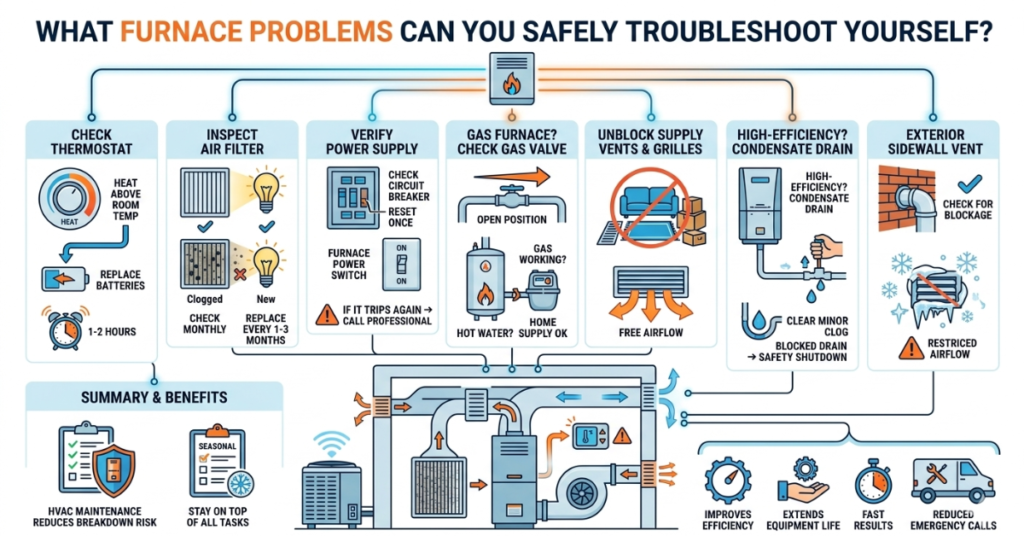
Before calling for professional service, there are several simple checks that may resolve your furnace issue or at least help you describe the problem more accurately when you do call for help. These steps are safe for any homeowner and don’t require specialized tools or training.
Start with your thermostat. Confirm it’s set to “heat” mode and that the temperature setting is above the current room temperature. If your thermostat uses batteries, replace them. It sounds basic, but a surprising number of service calls turn out to be nothing more than a thermostat that was accidentally bumped to “cool” or “off” during cleaning.
Check your air filter next. Pull the filter out and hold it up to a light source. If you can’t see light through it, it’s too dirty and needs to be replaced. A new furnace filter costs $10 to $70 depending on the size and type. During heating season, check the filter monthly and replace it every one to three months, more frequently if you have pets or live in a dusty area.
Verify that the furnace has power by checking the circuit breaker and the furnace power switch, which is usually located on or near the unit and looks like a standard light switch. If the breaker has tripped, reset it once. If it trips again, that indicates an electrical problem that requires professional diagnosis.
For gas furnaces, make sure the gas valve is in the open position. Follow the gas line from the furnace back toward the supply and check that no valves have been accidentally turned off. If your hot water heater also runs on gas and it’s working normally, the gas supply to your home is likely fine.
Walk through your home and check all supply vents and return air grilles. Make sure none are blocked by furniture, rugs, or stored items. Restricted airflow from blocked vents creates the same problems as a dirty filter, forcing the furnace to work harder than it should.
If you have a high-efficiency condensing furnace, check the condensate drain line for clogs. These furnaces produce water during operation, and a blocked drain line will trigger a safety shutdown. You can often clear a minor clog by carefully blowing through the line or flushing it with a small amount of water.
Finally, if your furnace vents through a sidewall rather than a roof, check the exterior vent for ice, snow, or debris blockage. Oklahoma ice storms can coat exterior vents and restrict airflow, causing the furnace to shut down as a safety precaution. Keeping your seasonal HVAC maintenance checklist current helps you stay on top of all these tasks throughout the year.
When Should You Call a Professional for Furnace Repair?
While basic troubleshooting is safe for any homeowner, certain furnace problems require professional expertise and should never be handled as DIY projects. Knowing where that line falls protects both your safety and your equipment.
Gas Smells or Carbon Monoxide Concerns
If you smell natural gas (a rotten egg odor added by your gas utility) near your furnace or anywhere in your home, do not attempt to investigate or repair anything. Leave your home immediately, avoid turning on or off any electrical switches, and call your gas company and 911 from outside. Gas leaks are emergencies that require immediate professional response.
A yellow or flickering burner flame is another urgent safety concern. A healthy gas furnace produces a steady, crisp blue flame. A yellow flame indicates incomplete combustion, which means the furnace is producing elevated levels of carbon monoxide. The Oklahoma Office of Emergency Management specifically warns homeowners to watch flame color as a key indicator of carbon monoxide risk. If you see a yellow flame, shut the furnace off and call for professional furnace repair immediately.
Unusual Noises and Persistent Problems
Banging, squealing, rattling, or grinding sounds from your furnace indicate mechanical problems that will get worse without professional attention. Banging often means delayed ignition, where gas builds up before igniting. Squealing typically points to a worn belt or failing blower motor bearings. Rattling can indicate loose components or a deteriorating heat exchanger. None of these are safe to diagnose or repair without proper training and tools.
If your furnace keeps shutting down after you’ve replaced the filter and verified the thermostat settings, a deeper issue is at play. Repeated shutdowns can indicate a failing flame sensor, a cracked heat exchanger, electrical problems, or a refrigerant issue in a heat pump system. Professional diagnostics are needed to identify the root cause.
Heat Exchanger and Water Leak Concerns
A cracked heat exchanger is one of the most serious furnace problems because it can leak carbon monoxide directly into your home’s air supply. According to HomeGuide, replacing a heat exchanger costs $1,000 to $3,000, and most HVAC technicians replace rather than repair them due to the carbon monoxide risk. Signs of a cracked heat exchanger include soot buildup around the furnace, a strange formaldehyde-like smell, and visible cracks or corrosion on the exchanger itself.
Water pooling around your furnace can indicate a clogged condensate drain on a high-efficiency model, but it can also signal a cracked heat exchanger or a failing flue pipe. Either way, water and furnaces don’t mix safely, and a professional should evaluate the situation.
How Much Does Furnace Repair Cost in Oklahoma?
Understanding typical repair costs helps you make informed decisions about whether to repair or replace and prevents you from overpaying for service. Here’s what Oklahoma homeowners can generally expect based on current industry data.
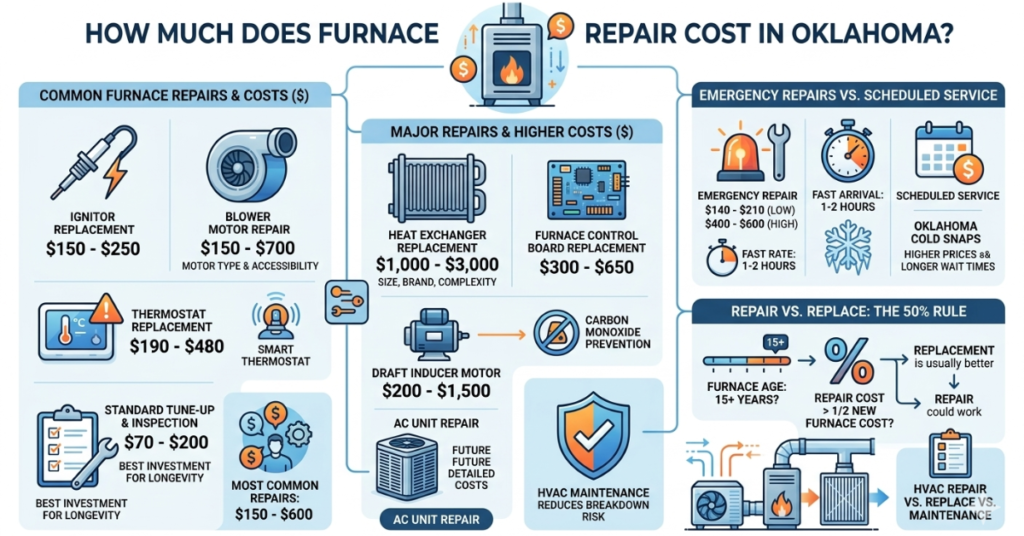
For most common furnace repairs, homeowners spend between $150 and $600. An ignitor replacement, one of the most frequent repairs, typically runs $150 to $250 during normal business hours. Blower motor repairs range from $150 to $700 depending on the motor type and accessibility. Thermostat replacement costs $190 to $480, with smart thermostats at the higher end. A standard tune-up and inspection costs $70 to $200 and is one of the best investments you can make in your system’s longevity.
Major repairs carry significantly higher price tags. A heat exchanger replacement runs $1,000 to $3,000 depending on the furnace size, brand, and complexity. A furnace control board replacement costs $300 to $650. A draft inducer motor, which prevents carbon monoxide buildup, costs $200 to $1,500 to repair or replace.
Emergency repairs cost substantially more than scheduled service. According to HomeGuide, emergency HVAC service rates run $140 to $210 per hour on the low end and $400 to $600 per hour on the high end. During Oklahoma cold snaps when demand is highest, wait times increase and premium pricing is standard.
A useful rule of thumb for deciding between repair and replacement is the 50% rule: if a repair costs more than half the price of a new furnace, replacement is usually the better long-term investment. This is especially true for furnaces older than 15 years. For a detailed breakdown of when each option makes sense, review the guide on HVAC repair vs. replacement vs. maintenance.
Why Does Oklahoma Weather Make Furnace Maintenance So Important?
Oklahoma’s climate puts unique demands on heating systems that homeowners in more temperate or consistently cold regions don’t face. Understanding these demands helps explain why proactive maintenance matters so much here.
The biggest challenge is Oklahoma’s rapid temperature swings. A furnace that sat idle during a 70-degree afternoon may need to run continuously through a night that drops into the teens or single digits. That sudden shift from dormant to full-load operation stresses every component in the system, particularly the ignitor, flame sensor, and blower motor. Furnaces that haven’t been professionally maintained are far more likely to fail during these transitions because worn components that functioned adequately under light use can’t handle sustained demand.
Oklahoma’s history of severe winter events reinforces this point. The Oklahoma Climatological Survey documented the February 2021 arctic blast in which 96 of 120 Mesonet weather stations recorded their lowest temperatures ever, and parts of the state remained below freezing for over 200 consecutive hours. Hundreds of thousands of homes lost power, and furnace failures during that period left families in dangerous conditions with no backup heating.
Ice storms are another recurring threat. The 2007 ice storm left 640,000 Oklahoma residents without power, with some outages lasting over a week. According to NOAA, Oklahoma experienced 7 billion-dollar winter storm events between 1980 and 2024. Each of these events created surges in emergency heating service demand that overwhelmed local HVAC providers, leaving homeowners who hadn’t maintained their systems waiting days for repairs in freezing conditions.
When your furnace is the only thing standing between your family and dangerous cold, having it professionally inspected before winter is not optional. If your system fails during a major weather event, emergency HVAC service is available, but response times are longer and costs are significantly higher during peak demand.
How Can You Prevent Furnace Problems Before Winter Hits?
The most effective and affordable approach to furnace care is preventing problems before they develop. A combination of homeowner habits and professional maintenance catches the vast majority of issues while they’re still small and inexpensive to address.
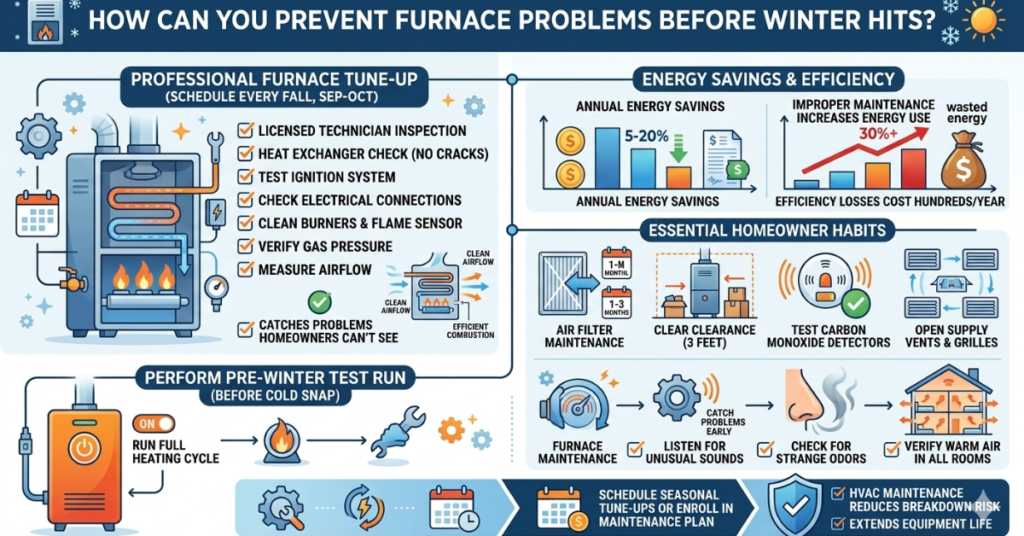
Schedule a professional furnace tune-up every fall, ideally in September or October before you need the system for daily use. During a tune-up, a licensed technician inspects the heat exchanger for cracks, tests the ignition system, checks electrical connections, cleans the burners and flame sensor, verifies gas pressure, and measures airflow. These are the checks that catch problems homeowners simply can’t see or test on their own.
The U.S. Department of Energy estimates that proper HVAC maintenance delivers 5 to 20 percent in annual energy savings. Research documented in NIST Technical Note 1848 found that improper maintenance increases household HVAC energy use by 30 percent or more. Those efficiency losses compound over time, costing you hundreds of dollars in wasted energy each year while accelerating wear on your equipment.
Between professional visits, build these habits into your routine. Replace the air filter every one to three months and check it monthly during heavy-use periods. Keep the area around your furnace clear of stored items, with at least three feet of clearance on all sides. Test your carbon monoxide detectors at the start of each heating season and replace batteries annually. Verify that all supply vents and return air grilles throughout your home are open and unobstructed.
Before the first cold snap of the season, turn your furnace on and let it run through a full heating cycle while you’re home and alert. Listen for unusual sounds, check for strange odors, and verify that warm air is reaching all rooms. Catching a problem during a test run in October is far better than discovering it during a December ice storm.
For homeowners who want a structured approach to year-round system care, scheduling seasonal tune-ups or enrolling in a maintenance plan ensures nothing falls through the cracks.
Girdner Heat and Air Keeps Oklahoma Homes Warm and Safe
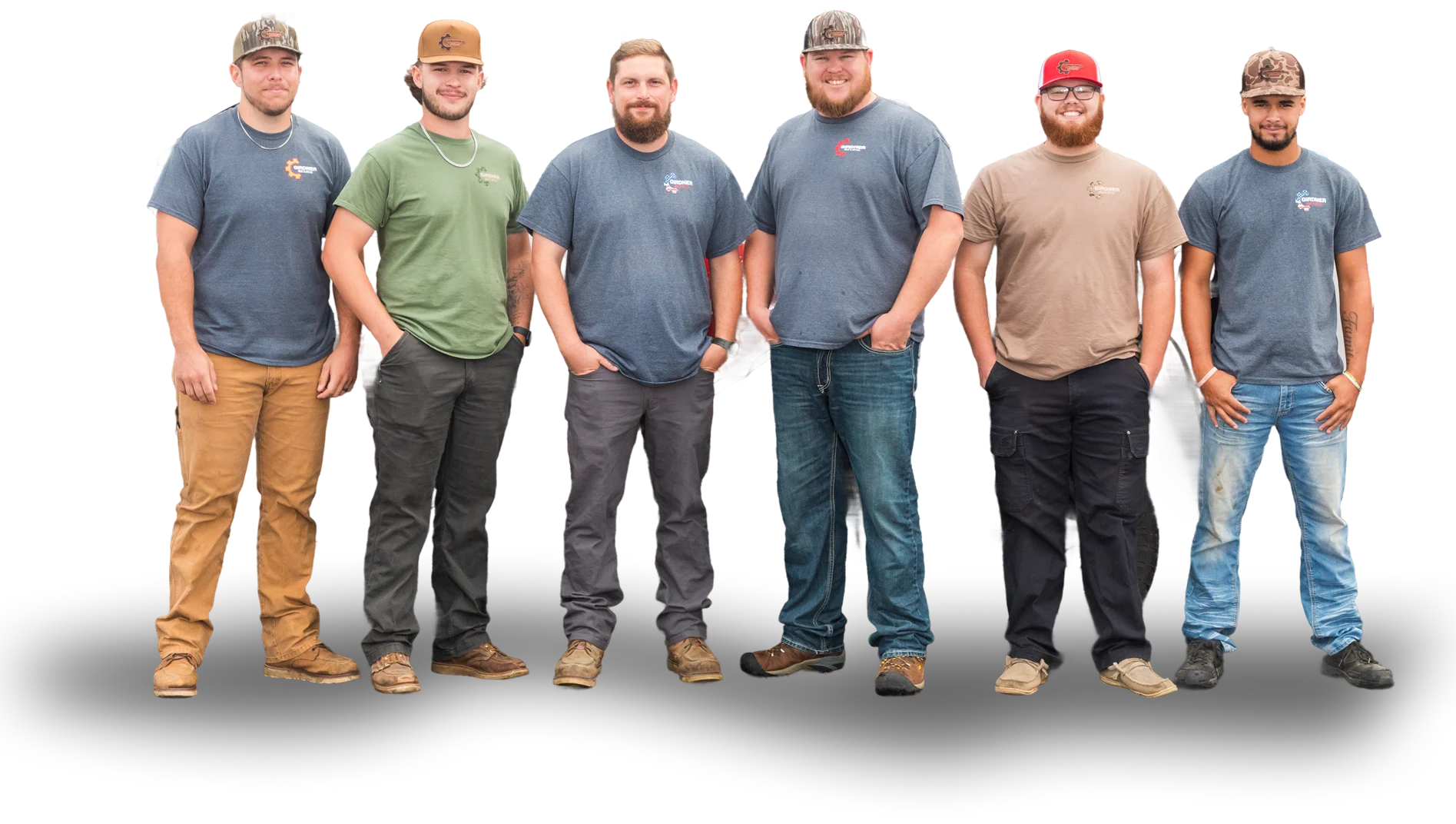
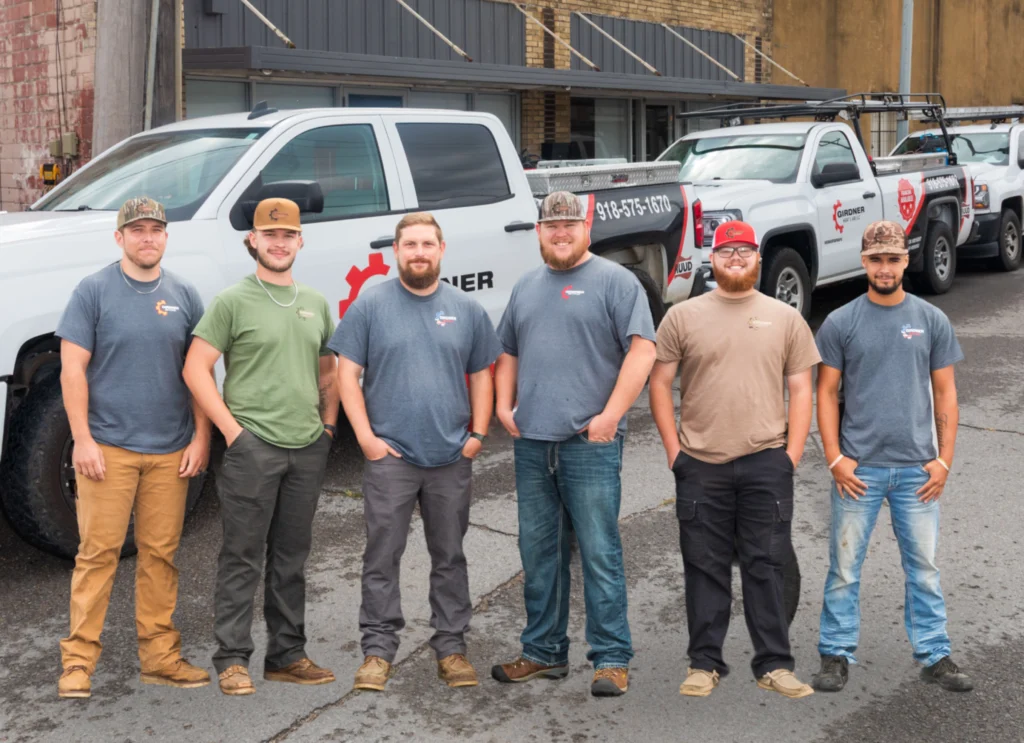
Your furnace is responsible for keeping your family comfortable and safe through every Oklahoma winter, from the mild cool-downs to the once-in-a-generation ice storms. Whether you’re dealing with a furnace that won’t start, strange noises from your heating system, or you simply want the peace of mind that comes from a professional inspection, Girdner Heat and Air is here to help.
Our licensed technicians provide thorough furnace repair services for homeowners across Stilwell, Oklahoma and the surrounding Oklahoma and Arkansas communities. We diagnose problems accurately, explain your options clearly, and make repairs that last.
Don’t wait for the coldest night of the year to find out your furnace needs help. Consider enrolling in a maintenance plan that includes scheduled inspections, priority service, and discounted repairs. Give Girdner Heat and Air a call today and let’s make sure your furnace is ready for whatever Oklahoma’s winter throws at it.