Skip to content

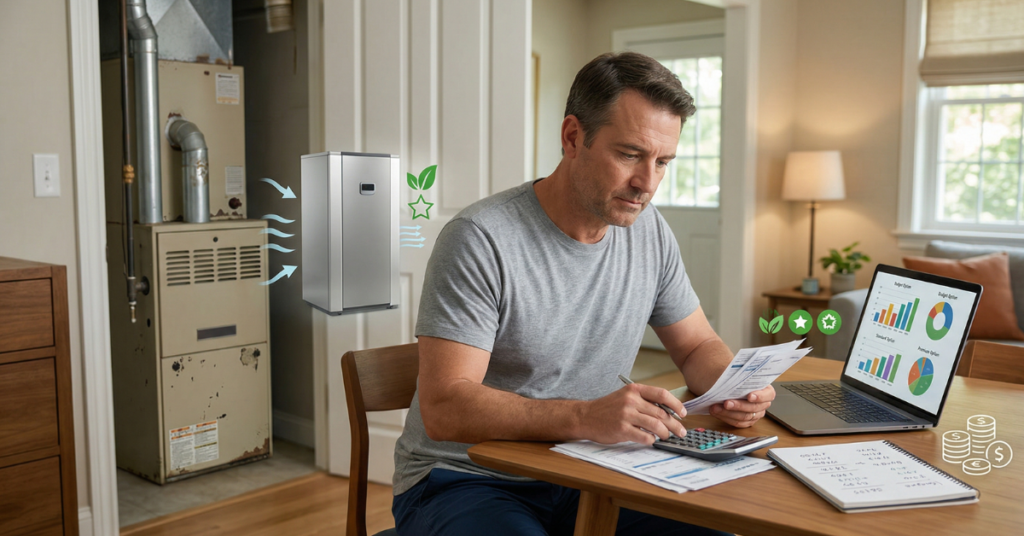
A full HVAC replacement costs $5,000 to $12,500 on average, with complex installations or high-efficiency systems reaching $15,000 or more. The best way to budget for this expense is to start setting aside $50 to $100 per month once your system passes the 10-year mark, explore financing and rebate options before you need them, and schedule your replacement during the off-season when prices are lower and contractor availability is better.
Replacing your heating and cooling system is one of the largest home expenses you’ll face, but it doesn’t have to catch you off guard. With some advance planning, a clear understanding of what drives costs, and knowledge of the financial tools available to you, this investment becomes manageable rather than overwhelming. This guide walks Oklahoma homeowners through every step of budgeting for HVAC replacement, from understanding the real costs to maximizing savings.
Key Takeaways
- A full HVAC replacement costs $5,000 to $12,500 on average, with most homeowners paying around $7,500 for a standard system including equipment and installation labor.
- Hidden costs like ductwork repairs, electrical upgrades, and permits can add $1,500 to $5,000 beyond the initial equipment and labor quote, so always request a detailed, itemized estimate.
- Start building an HVAC savings fund once your system hits 10 years old by setting aside $50 to $100 per month in a dedicated account.
- The federal 25C energy efficient home improvement tax credit expired December 31, 2025, but state rebates, utility incentives, and manufacturer promotions may still help reduce your costs.
- Off-season installation (spring or fall) typically saves 10 to 15 percent compared to emergency replacements during peak summer or winter demand.
- Multiple financing options exist, including HVAC company promotional plans with 0% APR, personal loans, home equity loans, and credit cards, each suited to different financial situations.
How Much Does HVAC Replacement Actually Cost?
Understanding the full scope of replacement costs is the first step in building a realistic budget. The sticker price of a new unit is only part of the picture, and homeowners who plan only for equipment costs are often surprised by the final bill.
Cost Breakdown by System Type
According to HomeAdvisor, the average HVAC replacement costs around $7,500, with most homeowners paying between $5,000 and $12,500 for both the unit and professional installation. The final price depends heavily on the type of system, the size of your home, the efficiency rating you choose, and the complexity of the installation.
Central air conditioner replacements typically run $3,500 to $7,500 installed. Furnace replacements cost $3,500 to $6,000. A combined AC and furnace replacement for a standard Oklahoma home falls in the $7,500 to $12,000 range. Heat pump systems, which handle both heating and cooling, range from $4,000 to $8,000 for standard models and $8,000 to $15,000 or more for high-efficiency or dual-fuel configurations.
Home size plays a direct role in pricing. HVAC systems are sized in tons of cooling capacity, and the right size for your home depends on square footage, insulation quality, window placement, and local climate conditions. For homes under 1,200 square feet, a 1.5 to 2 ton system typically costs $4,500 to $8,000. For homes between 1,200 and 1,800 square feet, a 2.5 to 3 ton system runs $5,500 to $10,000. Larger homes of 1,800 to 2,500 square feet need 3.5 to 4 ton systems that cost $6,500 to $12,000 or more.
Efficiency ratings also affect pricing. A basic 14 SEER2 system costs significantly less upfront than a 20+ SEER2 model, but the higher-efficiency unit will reduce your monthly energy bills for the entire 15 to 20 year lifespan of the system. For most Oklahoma homeowners, a mid-range efficiency system in the 16 to 18 SEER2 range offers the best balance of upfront cost and long-term savings.
Hidden Costs Most Homeowners Miss
The quoted price for equipment and labor rarely tells the whole story. According to the HVAC Calculator Hub’s 2025 replacement cost guide, homeowners should budget an additional $1,500 to $5,000 beyond the base quote for common add-ons and necessary upgrades.
Ductwork is one of the most common hidden expenses. If your existing ductwork is leaky, undersized, or damaged, the new system won’t perform to its potential regardless of how efficient the unit itself is. Duct repairs can add $1,400 to $5,600 depending on the extent of the work needed. Electrical panel upgrades may be required if your home’s electrical system can’t support a modern HVAC unit, especially when switching from a gas furnace to a heat pump. Permit fees, thermostat upgrades, refrigerant line modifications, and disposal of the old equipment are additional costs that can add up quickly.
The best way to avoid surprises is to request detailed, itemized quotes from every contractor you consult. A reputable HVAC company will break out the cost of equipment, labor, permits, ductwork modifications, electrical work, and any other line items so you can see exactly where your money is going. If a quote includes only a single lump sum, ask for a breakdown before committing.
When Should You Start Saving for HVAC Replacement?
The worst time to think about paying for a new HVAC system is the day your current one dies. Planning ahead gives you more options, better pricing, and far less stress. Knowing when your system is approaching the end of its useful life helps you start saving at the right time.
The $5,000 Rule for Repair vs. Replacement
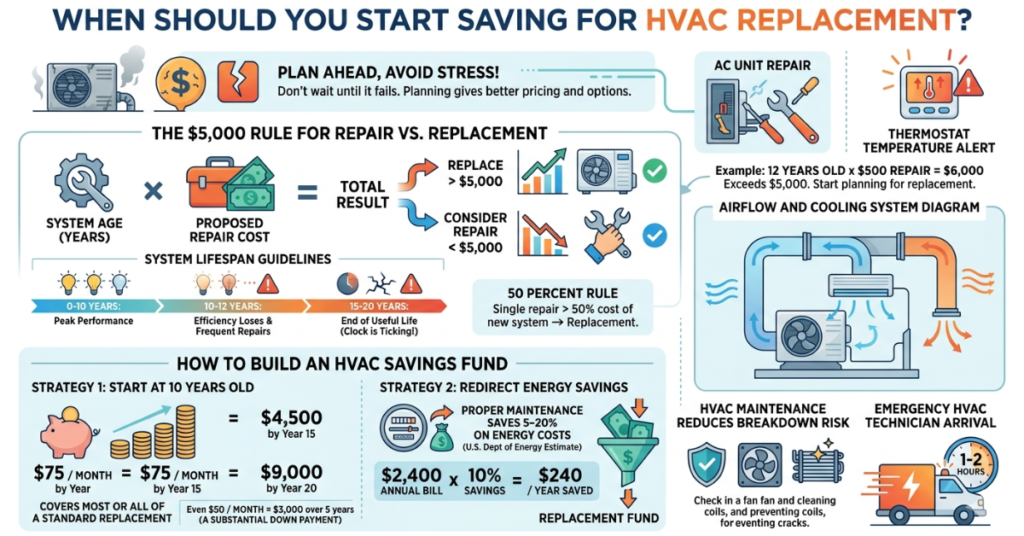
One of the most widely used decision-making tools in the HVAC industry is the $5,000 rule. Multiply the age of your system by the cost of the proposed repair. If the result exceeds $5,000, replacement is generally the better financial decision. For example, if your system is 12 years old and needs a $500 repair, the calculation is 12 times $500, which equals $6,000. That exceeds the $5,000 threshold, suggesting it’s time to start seriously planning for replacement rather than continuing to invest in repairs.
A related guideline is the 50 percent rule: if a single repair costs more than half the price of a new system, replacement makes more sense. Both of these frameworks help you avoid the common trap of spending $2,000 to $3,000 on repairs over two or three years only to replace the system anyway. For a detailed comparison of when to repair, replace, or maintain, review the guide on HVAC repair vs. replacement vs. maintenance.
Most residential HVAC systems last 15 to 20 years with proper maintenance, though many begin losing efficiency and requiring more frequent repairs after 10 to 12 years. If your system is approaching that range and showing signs your HVAC system is failing, the clock is ticking on replacement whether you’ve budgeted for it or not.
How to Build an HVAC Savings Fund
Once your system passes the 10-year mark, begin setting aside money specifically for replacement. A dedicated savings account, even one earning modest interest, creates a financial cushion that reduces or eliminates the need for financing when the time comes.
If you set aside $75 per month starting when your system turns 10, you’ll have $4,500 saved by year 15 and $9,000 by year 20. That covers most or all of a standard replacement. If $75 per month feels like too much, even $50 per month builds to $3,000 over five years, which can serve as a substantial down payment that reduces financing costs.
Another approach is to redirect the money you save on energy bills from annual maintenance. The U.S. Department of Energy estimates that proper HVAC maintenance saves 5 to 20 percent on annual energy costs. If your annual heating and cooling bills total $2,400, a 10 percent savings from maintenance puts $240 per year back in your pocket. Directing that savings into your HVAC replacement fund adds meaningfully over time.
What Rebates, Tax Credits, and Incentives Can Reduce the Cost?
Financial incentives from federal, state, and utility programs can significantly reduce the out-of-pocket cost of HVAC replacement, but the landscape has recently changed. Understanding what’s currently available helps you maximize savings and time your purchase strategically.
The federal Energy Efficient Home Improvement Credit (Section 25C) provided homeowners with a tax credit of 30 percent of the cost of qualifying energy-efficient HVAC equipment, up to $2,000 per year for heat pumps and $600 for central air conditioners. According to the IRS, this credit applied to qualifying systems installed in a taxpayer’s primary residence through December 31, 2025. The credit has now expired for installations completed in 2026 or later. However, homeowners who installed qualifying equipment before the deadline can still claim the credit when filing their 2025 taxes during the 2026 tax season using IRS Form 5695.
Even without the federal 25C credit, several other financial incentives may still be available. The Residential Clean Energy Credit (Section 25D) continues through 2032 for geothermal heat pump installations, covering 30 percent of equipment and installation costs with no dollar cap. State and local utility rebates vary by region and often change annually, so check with your local utility provider for current offerings. Manufacturer rebates and seasonal promotions from major HVAC brands can also reduce equipment costs by hundreds of dollars.
The key takeaway for Oklahoma homeowners is to research available incentives before committing to a purchase. Your HVAC contractor should be familiar with current programs and can help you identify which rebates apply to your specific project. Even modest incentives of $500 to $1,000 make a meaningful difference when combined with other budgeting strategies.
What HVAC Financing Options Are Available?
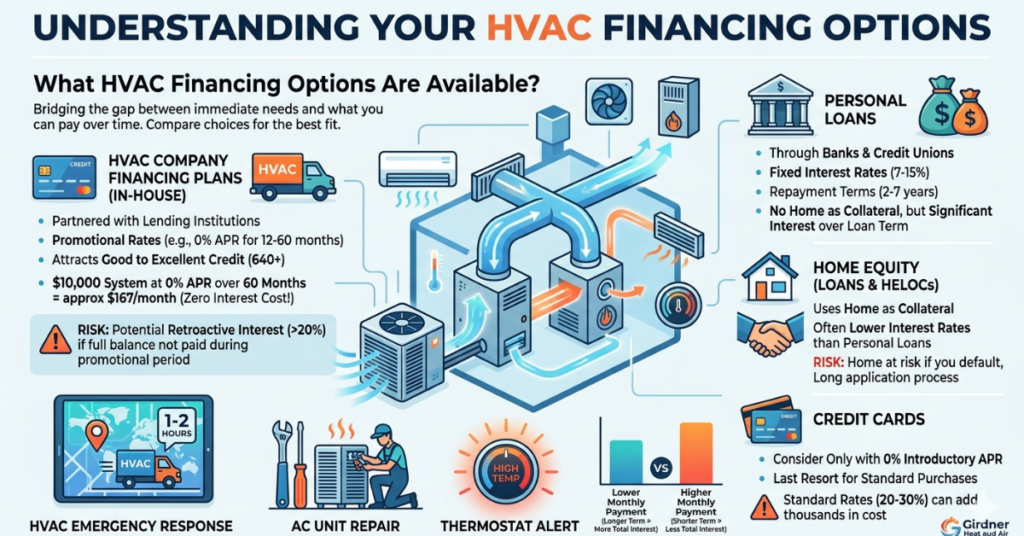
Most homeowners don’t have $7,500 to $12,500 sitting in a savings account waiting for an HVAC replacement. Financing bridges the gap between what you need now and what you can pay over time, but not all financing options are created equal. Understanding the differences helps you choose the path that costs the least and fits your financial situation.
HVAC Company Financing Plans
Many HVAC companies partner with lending institutions to offer in-house financing specifically designed for heating and cooling purchases. According to Bryant, these plans often include promotional rates such as 0 percent APR for 12 to 60 months, making them one of the most attractive options when available.
The appeal of 0 percent financing is straightforward: you pay only the cost of the system with no interest charges, as long as you pay off the balance within the promotional period. For a $10,000 system financed at 0 percent over 60 months, your payment would be approximately $167 per month with zero interest cost. However, these plans typically require good to excellent credit (640 or higher) and carry an important risk: if you don’t pay off the full balance before the promotional period ends, interest may be charged retroactively on the entire original amount at rates that can exceed 20 percent.
Girdner Heat and Air offers HVAC financing options to help make replacement more accessible. Ask about current promotional rates and terms during your consultation.
Personal Loans, Home Equity, and Credit Cards
Beyond HVAC-specific financing, several other options are available. Personal loans through banks or credit unions typically carry fixed interest rates of 7 to 15 percent with repayment terms of 2 to 7 years. They don’t require your home as collateral, but the interest costs can be significant over the life of the loan.
Home equity loans and home equity lines of credit (HELOCs) use the equity in your home as collateral, which often results in lower interest rates than personal loans. However, this means your home is at risk if you default, and the application process takes longer than other financing methods.
Credit cards should generally be a last resort for HVAC purchases unless you have a card with a 0 percent introductory APR and a plan to pay off the balance before the promotional period expires. Standard credit card interest rates of 20 to 30 percent can add thousands of dollars to the cost of your system if you carry a balance.
Whichever financing path you choose, compare the total cost of the loan (principal plus all interest and fees) rather than focusing only on the monthly payment. A lower monthly payment spread over a longer term often costs significantly more in total than a higher payment over a shorter period.
How Can You Save Money on HVAC Replacement?
Beyond rebates and financing, several practical strategies can reduce the total cost of your HVAC replacement without sacrificing quality or comfort.
Timing your purchase during the off-season is one of the simplest ways to save. According to the HVAC Calculator Hub, scheduling installation in spring or early fall typically saves 10 to 15 percent compared to peak-season pricing. Emergency replacements during the hottest weeks of summer or the coldest days of winter can cost 30 percent more than planned installations because contractors charge premium rates during high-demand periods and have less flexibility on scheduling.
Getting multiple quotes is essential. Labor accounts for roughly 40 percent of the total replacement cost, and labor pricing varies significantly between contractors. Getting three to five detailed quotes on the same system gives you negotiating leverage and helps you identify fair pricing. Make sure each quote covers the same equipment specifications, efficiency ratings, warranty terms, and scope of work so you’re comparing equivalent proposals.
Right-sizing your system matters more than most homeowners realize. An oversized system costs more to purchase, cycles on and off too frequently, wears out components faster, and doesn’t properly control humidity. An undersized system runs constantly and can’t keep up with demand. A proper Manual J load calculation by a qualified technician ensures you get the right-sized system for your home, which saves 5 to 10 percent on the initial purchase and reduces long-term operating costs.
Consider mid-range equipment rather than the cheapest or most expensive options. Entry-level systems save money upfront but often come with shorter warranties and lower efficiency. Premium systems offer the best performance but may not deliver enough additional value to justify the price difference for every homeowner. For most Oklahoma homes, a mid-tier system from a reputable manufacturer offers the best combination of reliability, efficiency, warranty coverage, and cost.
How Does Regular Maintenance Help You Budget Better?
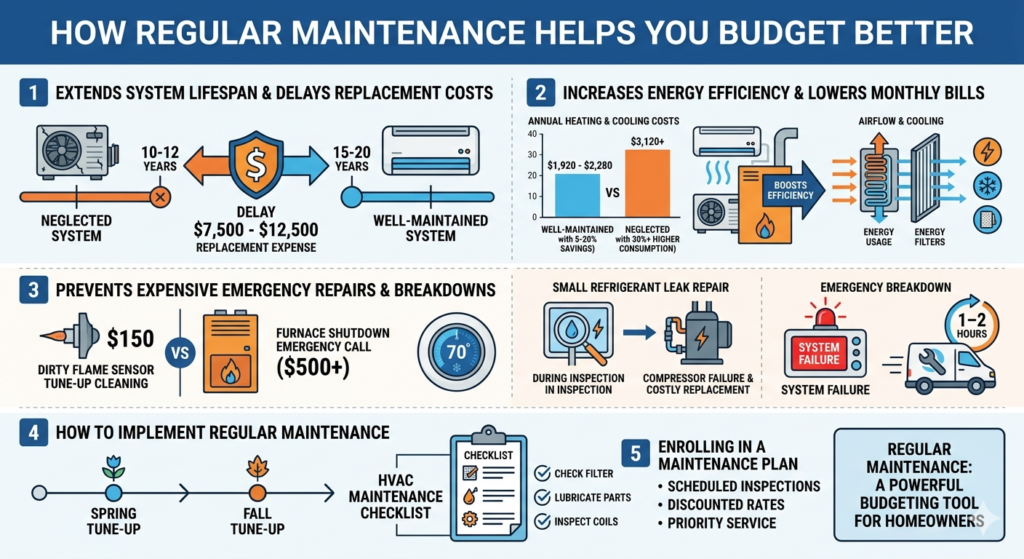
Consistent maintenance is one of the most effective budgeting tools available to homeowners because it addresses both sides of the equation: it extends the life of your current system (delaying the replacement expense) and it keeps the system running efficiently (reducing your monthly operating costs).
The U.S. Department of Energy estimates that proper maintenance delivers 5 to 20 percent in annual energy savings. Research documented in NIST Technical Note 1848 found that neglected maintenance increases HVAC energy consumption by 30 percent or more. For a household spending $2,400 per year on heating and cooling, that’s a difference of $720 annually between a well-maintained and a neglected system.
Beyond energy savings, maintenance prevents the small problems that become expensive repairs. A dirty flame sensor that costs $150 to clean during a tune-up can cause a complete furnace shutdown that costs $500 or more as an emergency call. A refrigerant leak caught early during a spring inspection costs far less to repair than the compressor failure it eventually causes if left unaddressed.
Well-maintained systems also last longer. A properly cared-for HVAC system can reach the upper end of its 15 to 20 year expected lifespan, while a neglected system may fail at 10 to 12 years. That difference of 5 to 8 additional years of service translates directly into thousands of dollars of value, because you’re delaying a $7,500 to $12,500 replacement expense.
Following a seasonal HVAC maintenance checklist and scheduling professional seasonal tune-ups twice per year keeps your system in peak condition. Enrolling in a maintenance plan with a trusted provider ensures these inspections happen on schedule, often at discounted rates with priority service when you need repairs.
Girdner Heat and Air Makes HVAC Replacement Affordable
Budgeting for HVAC replacement is about planning ahead, understanding your options, and working with a contractor you trust to give you honest pricing and expert guidance. Whether you’re five years away from replacement or facing the decision right now, having a clear financial plan takes the stress out of one of the biggest investments you’ll make in your home.
Girdner Heat and Air provides transparent, detailed estimates for homeowners across Stilwell, Oklahoma and the surrounding Oklahoma and Arkansas communities. We walk you through every cost, explain your equipment options, help you identify available rebates and incentives, and offer HVAC financing to fit your budget. Our goal is to make sure you feel confident in your investment and comfortable in your home for years to come.
Give Girdner Heat and Air a call today for a free consultation on your HVAC replacement options, or ask about our maintenance plan to extend the life of your current system while you save for the future.