Skip to content

Oklahoma landlords are legally required to maintain HVAC systems in safe, working condition under the state’s implied warranty of habitability. Tenants are responsible for basic upkeep like filter changes and reporting problems promptly. When both sides understand their roles, the system lasts longer, energy bills stay lower, and costly disputes stay off the table.
Whether you own a rental property in the Stilwell area or you’re renting a home in eastern Oklahoma or Arkansas, HVAC maintenance affects your comfort, your budget, and your legal standing. This guide breaks down who handles what, why proactive maintenance saves thousands of dollars over time, what should happen during professional inspections, and how to handle HVAC emergencies in rental situations.
Key Takeaways
- Oklahoma law (41 O.S. Section 118) requires landlords to keep HVAC systems in good, safe working order as part of the implied warranty of habitability, and tenants who report issues in writing can pursue repair-and-deduct remedies if landlords fail to act within 14 days.
- Preventive maintenance programs reduce HVAC service requests by 31 to 50 percent and cut HVAC-related operating expenses by 12 to 18 percent across rental portfolios.
- Tenant turnover costs $1,000 to $5,000 per unit on average, and 63 percent of tenants dissatisfied with maintenance say they plan to move within 12 months.
- Annual professional tune-ups cost $150 to $300 per unit but help prevent emergency repairs that run three to five times higher than routine service calls.
- Clear lease language about HVAC responsibilities prevents disputes and protects both landlords and tenants from unexpected costs.
Why Is HVAC Maintenance for Rental Properties Important?
HVAC maintenance in rental properties is a shared responsibility, but landlords carry the larger legal obligation. Understanding where the line falls between landlord duties and tenant duties prevents disputes and keeps systems running efficiently.
What Oklahoma Law Requires from Landlords
Under Oklahoma Statute 41-118, landlords must maintain all heating, ventilating, and air-conditioning systems in good and safe working order throughout the tenancy. This obligation is part of the implied warranty of habitability, which means landlords can’t simply ignore a broken furnace or a failing air conditioner and expect tenants to deal with it.
According to Nolo’s overview of Oklahoma landlord-tenant law, if a landlord fails to address an HVAC issue that affects health and safety after receiving written notice, the tenant can give the landlord 14 days to make repairs. If the repair costs one month’s rent or less and the landlord doesn’t act, the tenant can have the work done and deduct the cost from rent. For more severe habitability violations, tenants can terminate the lease with 30 days’ written notice if the landlord doesn’t respond within 14 days.
In practical terms, landlord HVAC responsibilities include scheduling and paying for professional inspections, covering the cost of major repairs and component replacements, replacing the system when it reaches the end of its useful life, and ensuring the system meets current safety standards. These aren’t optional courtesies. They’re legal obligations that carry real consequences if ignored.
What Tenants Are Expected to Do
Tenants also have specific duties under Oklahoma law. The Oklahoma Landlord-Tenant Act (41 O.S. Section 127) requires tenants to avoid misusing HVAC systems and to report maintenance issues to the landlord promptly. Failing to report a problem that gets worse over time can shift some financial responsibility to the tenant.
Day-to-day tenant responsibilities typically include replacing or cleaning air filters on a regular schedule, keeping supply vents and return air grilles unobstructed, maintaining reasonable thermostat settings and avoiding extreme temperature swings, reporting any unusual noises, smells, or performance changes as soon as they notice them, and keeping the area around indoor and outdoor HVAC units clear of clutter and debris. These small tasks make a measurable difference. The EPA estimates that regular filter changes alone can reduce monthly heating and cooling bills by 5 to 15 percent.
Why Does Rental Property HVAC Maintenance Matter So Much Financially?
HVAC systems represent one of the single largest mechanical investments in any rental property. A full system replacement averages $5,000 to $12,500 depending on the system type, size, and efficiency rating. Protecting that investment through regular maintenance isn’t just good practice. It’s basic financial strategy for any landlord.
The Cost of Reactive vs. Preventive Maintenance
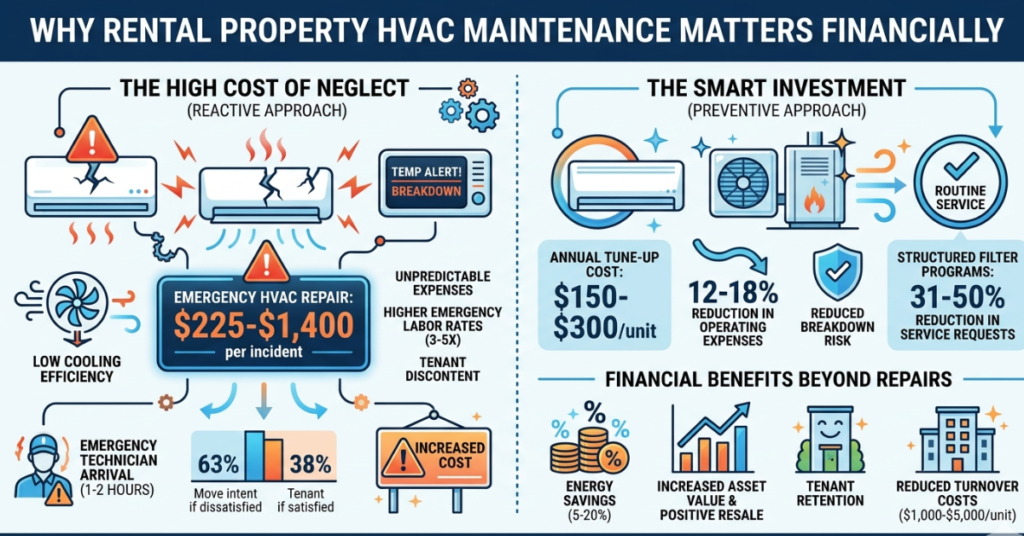
The difference between reactive and preventive HVAC maintenance is dramatic when you look at the numbers across a rental portfolio. According to Lula’s analysis of single-family rental properties, HVAC repair costs typically range from $225 to $1,400 per incident, while full system replacements run $2,300 to $7,000 per home. During emergencies, overtime labor rates and expedited parts sourcing can push those costs three to five times higher than routine service.
Preventive maintenance shifts spending from unpredictable emergencies to scheduled, budgetable service. Bi-annual professional tune-ups typically cost $150 to $300 per unit annually, and across rental portfolios, preventive programs deliver 12 to 18 percent reductions in HVAC-related operating expenses. A study by the National Rental Home Council tracking over 100,000 rental units found that structured filter delivery and maintenance programs reduced HVAC service requests by 31 to 50 percent across four major rental operators.
The U.S. Department of Energy estimates that proper HVAC maintenance delivers 5 to 20 percent in annual energy savings. Research from NIST Technical Note 1848 found that improper maintenance increases household HVAC energy use by 30 percent or more. For landlords who include utilities in rent, that inefficiency comes directly out of your margins. For tenants paying their own utilities, it means higher monthly bills that contribute to dissatisfaction.
How HVAC Problems Drive Tenant Turnover
The financial impact of neglected HVAC maintenance extends well beyond repair bills. Tenant turnover is one of the most expensive events a landlord faces, with average costs reaching $1,000 to $5,000 per unit when you factor in vacancy loss, cleaning, marketing, screening, and make-ready repairs.
HVAC performance plays a direct role in whether tenants stay or leave. Research from AppFolio cited by Lula found that 63 percent of tenants dissatisfied with maintenance say they plan to move within 12 months, compared to just 38 percent of satisfied tenants. When a tenant’s heating fails in January or their air conditioning struggles through an Oklahoma summer, frustration builds quickly. Unlike cosmetic issues that tenants may tolerate, temperature control problems disrupt daily life and push even otherwise content renters toward the exit.
Beyond turnover, neglected HVAC systems also affect property value. Documented maintenance history demonstrates responsible ownership, which can positively influence refinancing opportunities, property sales, and investor confidence. Deferred maintenance does the opposite, lowering perceived asset quality and giving buyers leverage to negotiate your price down.
What HVAC Maintenance Should Landlords Schedule Each Year?
Professional HVAC maintenance is the landlord’s responsibility and should happen on a predictable schedule. The goal is to catch problems while they’re small and inexpensive, verify safety, and keep the system running at peak efficiency.
Spring and Fall Professional Tune-Ups
Schedule professional HVAC tune-ups twice per year, once in the spring before cooling season begins and once in the fall before heating season. These inspections cover everything a homeowner’s visual check can’t detect.
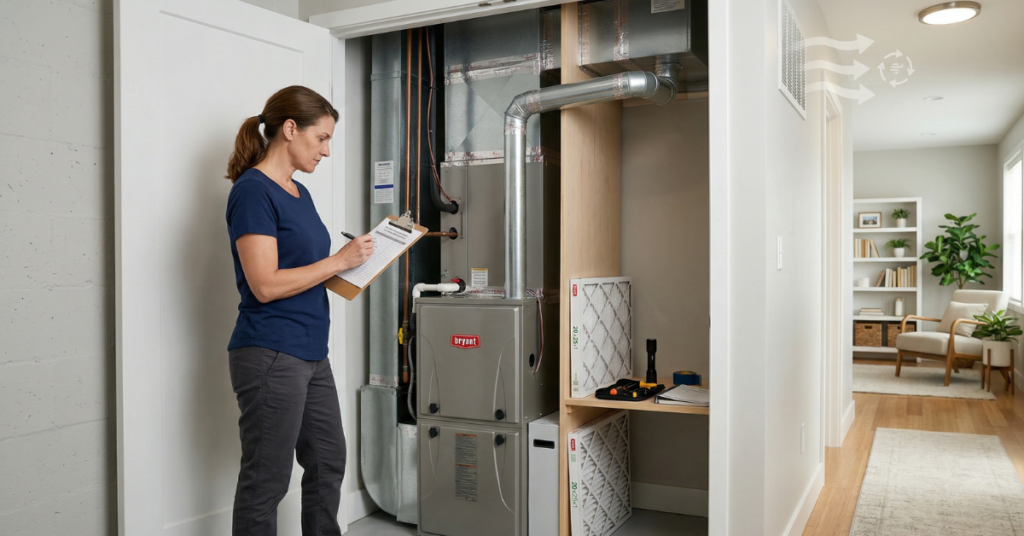
During a spring tune-up focused on cooling, the technician will clean the condenser coils, check refrigerant levels, inspect electrical connections, test the capacitor and contactor, verify thermostat calibration, clear the condensate drain line, and measure airflow and temperature differential across the system. A fall tune-up focused on heating includes inspecting the heat exchanger for cracks, testing the ignition system, cleaning the burners and flame sensor, checking the flue and venting, verifying gas pressure, and measuring carbon monoxide levels. You can use a seasonal HVAC maintenance checklist to track what’s been completed and when, which is especially helpful for landlords managing multiple properties.
The data supports the investment. According to Belong’s analysis of over 15,000 maintenance work orders, proactive maintenance routines cut emergency repair costs by 32 percent. Properties enrolled in regular maintenance programs had median costs of $0.62 per square foot, compared to $1.27 per square foot for properties with deferred maintenance. For a 1,500-square-foot rental, that’s the difference between $930 and $1,905 annually.
Turnover Inspections Between Tenants
Every time a tenant moves out, the HVAC system should receive a thorough inspection before a new tenant moves in. This is your opportunity to catch issues that developed during the previous tenancy and address them before they become the new tenant’s complaint.
A turnover HVAC inspection should include replacing the air filter, inspecting ductwork for visible damage or disconnections, testing the system in both heating and cooling modes, checking thermostat operation and battery condition, inspecting the condensate drain for clogs, and verifying all supply and return vents are open and undamaged. If the system shows any signs your HVAC system is failing, address them before the new tenant moves in. Starting a tenancy with a fully functional HVAC system sets the right tone and reduces the likelihood of early maintenance calls.
According to Lula’s research, neglected HVAC systems lose 25 to 40 percent of their expected lifespan due to accumulated stress from deferred maintenance. For a system that should last 15 to 20 years, that translates to losing 4 to 8 years of useful life. Scheduling seasonal tune-ups and turnover inspections prevents that accelerated decline.
What HVAC Tasks Should Tenants Handle?
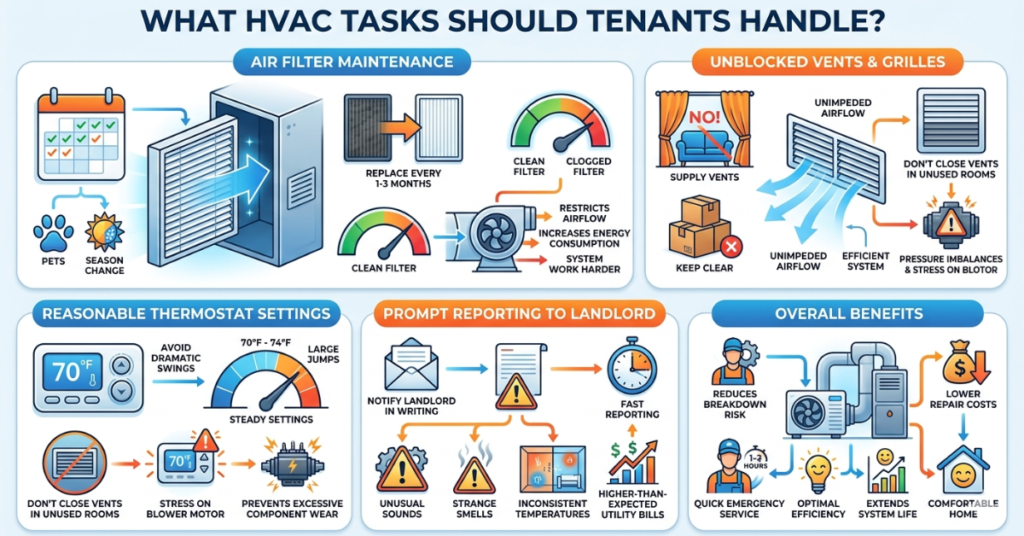
While landlords carry the responsibility for professional maintenance and major repairs, tenants play an essential role in keeping the system healthy between service visits. A tenant who understands basic HVAC care can prevent many of the problems that lead to expensive emergency calls.
The most important task is air filter maintenance. Tenants should check the filter monthly and replace it every one to three months, depending on the filter type, whether pets are present, and the season. A clogged filter restricts airflow, forces the system to work harder, increases energy consumption, and can trigger safety shutdowns. This is the single easiest way for tenants to protect the system and keep their utility bills in check.
Beyond filter changes, tenants should keep all supply vents and return air grilles open and unblocked by furniture, curtains, or stored items. Closing vents in unused rooms might seem like a way to save energy, but it actually creates pressure imbalances that stress the blower motor and reduce system efficiency. Tenants should also maintain reasonable thermostat settings and avoid dramatic swings. Setting the thermostat to 60 degrees while away and then cranking it to 78 when returning home forces the system into extended high-demand cycles that accelerate component wear.
Prompt reporting is just as important as hands-on care. If a tenant notices unusual sounds, strange smells, inconsistent temperatures, or higher-than-expected utility bills, they should notify the landlord in writing as soon as possible. Early reporting is often the difference between a $200 repair and a $2,000 emergency. A landlord who responds quickly to maintenance requests also builds the kind of trust that keeps good tenants renewing their leases year after year.
How Should Landlords and Tenants Handle HVAC Emergencies?
Not every HVAC problem is an emergency, but some situations require immediate response to protect health, safety, or the property itself. Both landlords and tenants need to know what qualifies as urgent and what the process looks like when an emergency occurs.
True HVAC emergencies include a gas smell near the furnace or anywhere in the home, which requires immediate evacuation and a call to the gas company. A complete heating failure when outdoor temperatures drop below freezing is a health and safety risk, especially for vulnerable occupants like young children or elderly tenants. Carbon monoxide detector activation in conjunction with HVAC operation requires evacuating the home and calling 911. Electrical burning smells or visible sparking near the HVAC system demand immediate shutdown and professional response. Water leaking from the HVAC system near electrical components or causing property damage also qualifies as urgent.
Tenants experiencing any of these situations should contact the landlord immediately by phone and follow up in writing. If the landlord is unreachable and the situation poses an immediate threat to health or safety, Oklahoma law allows tenants to take reasonable steps to address the danger. For situations that don’t threaten health or safety, such as a system that’s running but not cooling as efficiently as usual, written notice to the landlord with a reasonable timeframe for response is the appropriate approach.
Landlords should have emergency HVAC service contact information readily available and share it with tenants at the start of every lease. When emergencies arise during evenings, weekends, or holidays, having a trusted HVAC provider on call prevents delays that can escalate both the physical damage and the repair costs.
How Can a Maintenance Plan Protect Your Rental Investment?
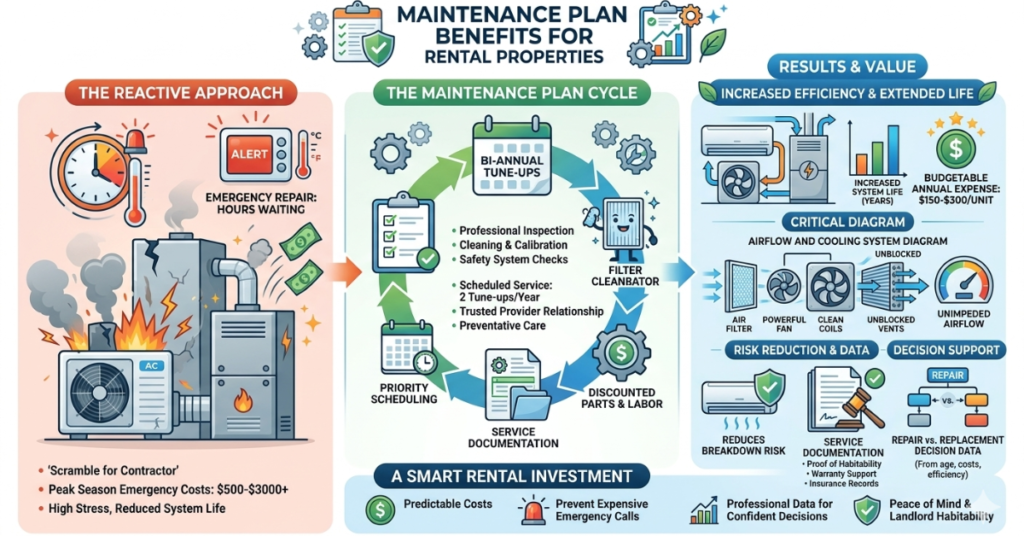
For landlords managing one rental property or several, an HVAC maintenance plan transforms HVAC care from a reactive headache into a predictable, budgetable expense. Instead of waiting for something to break and scrambling to find a contractor, a maintenance plan puts your system on a scheduled service cycle with a trusted provider.
A typical maintenance plan includes two professional tune-ups per year, priority scheduling for service calls, discounted rates on parts and labor, and documentation of all service performed on the system. That documentation matters more than many landlords realize. It serves as proof that you’ve met your habitability obligations, supports warranty claims, provides records for insurance purposes, and strengthens your position if a tenant dispute ever reaches court.
The financial case is straightforward. Bi-annual tune-ups cost $150 to $300 per unit annually through a maintenance plan. A single emergency repair during peak season can cost $500 to $3,000 or more. A full system replacement runs $5,000 to $12,500. By catching worn components before they fail, verifying safety systems are functional, and keeping the system clean and calibrated, maintenance plans help landlords avoid the most expensive outcomes while extending equipment life by years.
For landlords weighing the decision between ongoing maintenance and eventual replacement, the guide on HVAC repair vs. replacement vs. maintenance offers a detailed framework for making that decision based on system age, repair costs, and efficiency. A maintenance plan from a trusted local provider gives you the data and professional insight to make those decisions confidently.
Girdner Heat and Air Supports Oklahoma Landlords and Tenants
HVAC maintenance in rental properties protects your investment, keeps tenants comfortable, satisfies your legal obligations, and prevents the kind of emergency expenses that can wipe out months of rental income. Whether you own a single rental home near Stilwell or manage several properties across eastern Oklahoma and Arkansas, having a reliable HVAC partner makes the difference between reacting to problems and preventing them.
Girdner Heat and Air works with landlords and tenants throughout the Stilwell, Oklahoma area and surrounding communities. We provide professional seasonal tune-ups, turnover inspections, emergency repair response, and comprehensive maintenance plans designed to keep rental HVAC systems running safely and efficiently year-round.
Give Girdner Heat and Air a call today to set up a maintenance schedule for your rental properties, or ask about our maintenance plan options that make budgeting for HVAC care simple and predictable.