Skip to content


Mobile home AC installation costs about $2,500 to $8,000 depending on the system type, with most projects landing near $4,000 to $6,000. Manufactured homes need special equipment built for smaller ductwork, downflow airflow, and federal HUD standards, so a standard residential unit usually can’t be dropped in. Your best options are central air, packaged units, or ductless mini-splits, chosen based on whether your home has usable ducts.
Cooling a mobile home in Stilwell or anywhere across our Oklahoma and Arkansas service area comes with its own rules. This guide walks you through why mobile homes are different, which systems work best, what you’ll pay, and what happens on install day, so you can plan with confidence before the first hot stretch hits.
Key Takeaways
- Mobile home AC installation runs about $2,500 to $8,000 depending on system type and site conditions
- Manufactured homes need downflow equipment built for floor ducts and HUD safety standards
- The main options are central air, packaged units, and ductless mini-splits
- Single-wides usually need 1 to 2 tons of cooling, double-wides 1.25 to 4 tons
- Proper sizing prevents high energy bills, weak cooling, and short system life
Why Do Mobile Homes Need Special AC Systems?
Mobile homes need AC systems designed specifically for manufactured housing because of their compact mechanical spaces, smaller ductwork, and federal HUD construction standards. A standard residential unit often can’t be installed safely or legally in a mobile home without modification. Manufactured homes also arrive on-site partially built, which shapes how the HVAC system is designed and fitted.
This isn’t a minor detail. Picking the right type of equipment from the start saves you money, comfort, and headaches down the road.
How Is Mobile Home Ductwork Different?
Mobile home ductwork is smaller and routed differently than the ducts in a site-built house. While a traditional home might use ducts up to 20 inches across, mobile home ducts rarely exceed a foot because of the tight space under the floor and inside narrow walls.
Most manufactured homes also use downflow systems that push air through floor ducts, rather than the upflow or horizontal systems common in basements and attics. Because these smaller pathways react strongly to leaks, kinks, and crushed sections, proper sealing and airflow matter even more than in a regular home. There’s a safety angle too. HUD rules only allow Class 0 or Class 1 flexible duct in mobile homes, since these meet strict fire and smoke standards.
What Equipment Rules Apply to Mobile Homes?
Manufactured housing must meet federal HUD standards, and your AC equipment has to follow them. According to industry guidance, standard residential HVAC equipment often cannot be installed in a mobile home without modification because of duct size, airflow direction, and space limits.
That’s why so many mobile homes use packaged units or compact split systems built specifically for manufactured housing. A licensed technician makes sure your install meets code and runs safely, which protects both your warranty and your family.
What Are the Best AC Options for a Mobile Home?
The right AC system for your mobile home depends on whether you have existing ductwork, your climate, and your budget. Each option has clear trade-offs, so it helps to understand them before you choose.
Central Air and Packaged Units
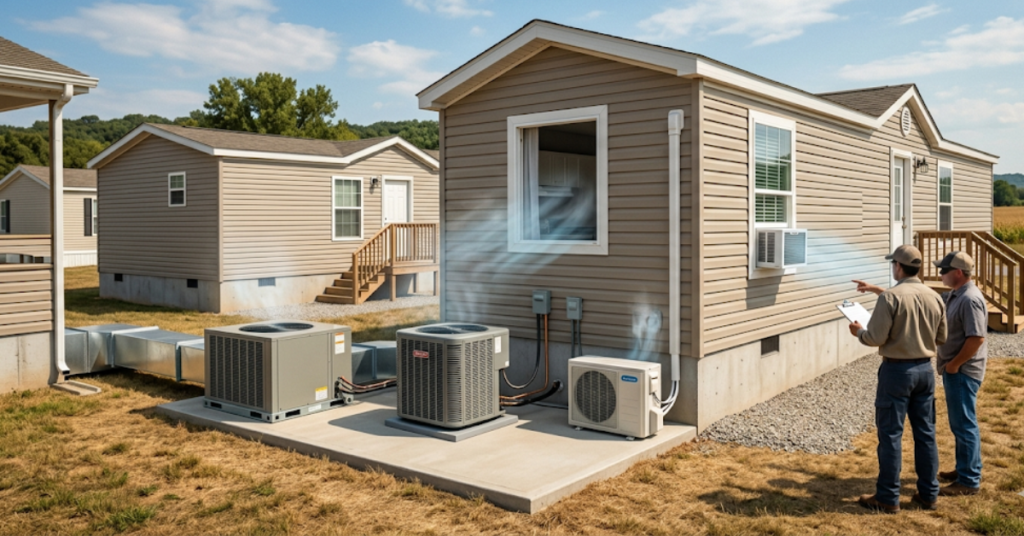
Central air is a strong choice for mobile homes that already have ductwork in good shape. Packaged units take this further by combining the heating and cooling components into a single outdoor cabinet, which is ideal when indoor space is tight. These self-contained units suit the downflow duct layout common in manufactured homes.
If you’re comparing whole-home options, our guide on central air vs mini split systems lays out the differences in plain terms.
Ductless Mini-Splits
Ductless mini-splits provide cooling without any ductwork at all, which makes them a great fit for homes that lack usable ducts or have rooms that never feel right. They offer zoned comfort, quiet operation, and good efficiency. The trade-off is a higher install cost, with a single indoor air handler running about $2,500 to $6,000.
Mini-splits also reduce the strain on older duct systems. The plan should match your whole home, though, not just the one room that feels warm.
Window and Portable Units
Window and portable units are the most budget-friendly way to cool a single room. A window unit costs roughly $300 to $1,100 installed, while portable units are even cheaper and need no installation at all.
The downside is they don’t cool a whole home well and can take up window or floor space. They work best as a backup or for a small space, not as your primary system.
How Much Does Mobile Home AC Installation Cost?
Installed mobile home AC units generally range from $2,500 to $8,000, with the average project around $4,000 to $6,000 for a central or ducted mini-split setup, based on recent cost data. System type and capacity are the largest cost drivers.
Here’s how the common options compare:
| System Type | Installed Cost Range |
| Window unit | $300 to $1,100 |
| Central air (cooling only) | $2,400 to $5,300 |
| Ductless mini-split | $2,500 to $6,000 |
| Packaged unit | $3,800 to $7,000 |
| Furnace and AC combo | $4,000 to $9,000 |
These figures come from 2026 HomeGuide pricing. Your final number depends on tonnage, efficiency rating, and any duct or vent work. Higher-efficiency units cost more up front but lower your monthly bills over time.
What Size AC Does a Mobile Home Need?
The right AC size for a mobile home depends on square footage, layout, climate, insulation, and ductwork quality, not just a quick rule of thumb. As a ballpark, single-wide homes often need 1 to 2 tons, while double-wides typically range from 1.25 to 4 tons because of their larger floor areas.
Sizing matters more than many homeowners expect:
- Undersized units can’t keep up and run constantly
- Oversized units short-cycle, which wastes energy and shortens the system’s life
- Right-sized units run steady, cool evenly, and stay quieter
A professional load calculation is the only reliable way to get this right. The same care that goes into sizing an air conditioner correctly for any home applies double in a mobile home, where thinner walls and greater heat gain change the math.

What Happens During a Mobile Home AC Installation?
A professional mobile home AC installation follows a clear sequence. Knowing the steps helps you understand the timeline and what your technician is doing.
- Assessment and load calculation. The technician measures your home, checks your ductwork, and calculates the right cooling capacity.
- System recommendation. Based on your home and budget, they suggest the best system type and size, then provide a quote.
- Old unit removal. Any existing equipment is disconnected and safely removed.
- New unit placement. The new system is set in position, whether that’s a packaged unit outside or a split setup.
- Duct and electrical connections. Ductwork is sealed and connected, and electrical work is completed to code.
- Testing and startup. The technician tests airflow, checks settings, and confirms safe, efficient operation before finishing.
Special site conditions, like narrow lot access or tie-down systems, can add labor and a little time. Most standard installs still wrap up smoothly with the right crew.
How Can You Keep Your Mobile Home AC Running Efficiently?
Keeping your mobile home AC efficient comes down to regular care and catching small problems early. Because mobile home ducts are sensitive to leaks and crushed sections, a little upkeep goes a long way toward steady comfort and lower bills.
Simple habits that help:
- Change your air filter on schedule
- Watch for uneven room temperatures or rising energy bills
- Listen for strange noises that signal airflow trouble
- Schedule a professional tune-up each year
A maintenance plan takes the guesswork out of this. Our AC maintenance plans include tune-ups and priority service that help your system run at its best through hot Oklahoma summers.
Stay Cool in Your Mobile Home This Summer
The right AC system, sized and installed for your manufactured home, makes a real difference in comfort and cost. Knowing your options, the price ranges, and the HUD rules ahead of time puts you in control of the decision. The key is choosing equipment built for mobile homes and a team that installs it right.
At Girdner Heat and Air, we serve mobile home owners across Stilwell and the surrounding Oklahoma and Arkansas communities with honest pricing and reliable AC installation. We’ll help you find the cooling system that fits your home and your budget, with no pressure.
Ready to stay comfortable all summer? Give us a call for a free estimate today.